Factorio Quality Calculator Guide: Space Age Upcycling & Legendary Items
A Factorio quality calculator is useful when fixed ratios stop working. Quality modules add probability, recyclers return only part of the input, and upcycling loops can multiply resource demand before a reliable rare, epic, or legendary output appears.
Last updated: May 7, 2026. This guide focuses on Factorio 2.0 and Space Age quality mechanics.
Quick Answer: What Should a Factorio Quality Calculator Do?
A good Factorio quality calculator should estimate how many normal inputs, machines, quality modules, recyclers, and loop cycles are needed to reach a target quality output. The key calculation is not just items per second; it is expected output per quality tier after crafting, recycling, and re-crafting.
- Use normal production ratios for simple outputs, but switch to quality calculations for uncommon, rare, epic, and legendary targets.
- Track the quality chance on each crafting step, because quality is probabilistic rather than guaranteed.
- Include recycler returns, because most upcycling setups depend on turning failed outputs back into ingredients.
- Separate exact facts from planning estimates: the game defines the mechanics, while your final item rate depends on machine choice, modules, recipes, recycling losses, and loop design.
Why Quality Planning Needs Its Own Page
The homepage Factorio calculator is still the main tool for recipe chains, while the ratios guide is best for memorized builds such as solar, steam, oil, belts, and science. Quality production deserves a separate guide because the player is usually asking a different question: how expensive is one higher-quality item after repeated attempts?
For memorized production values, use the Factorio ratios guide. For full recipe chains, start with the Factorio calculator.
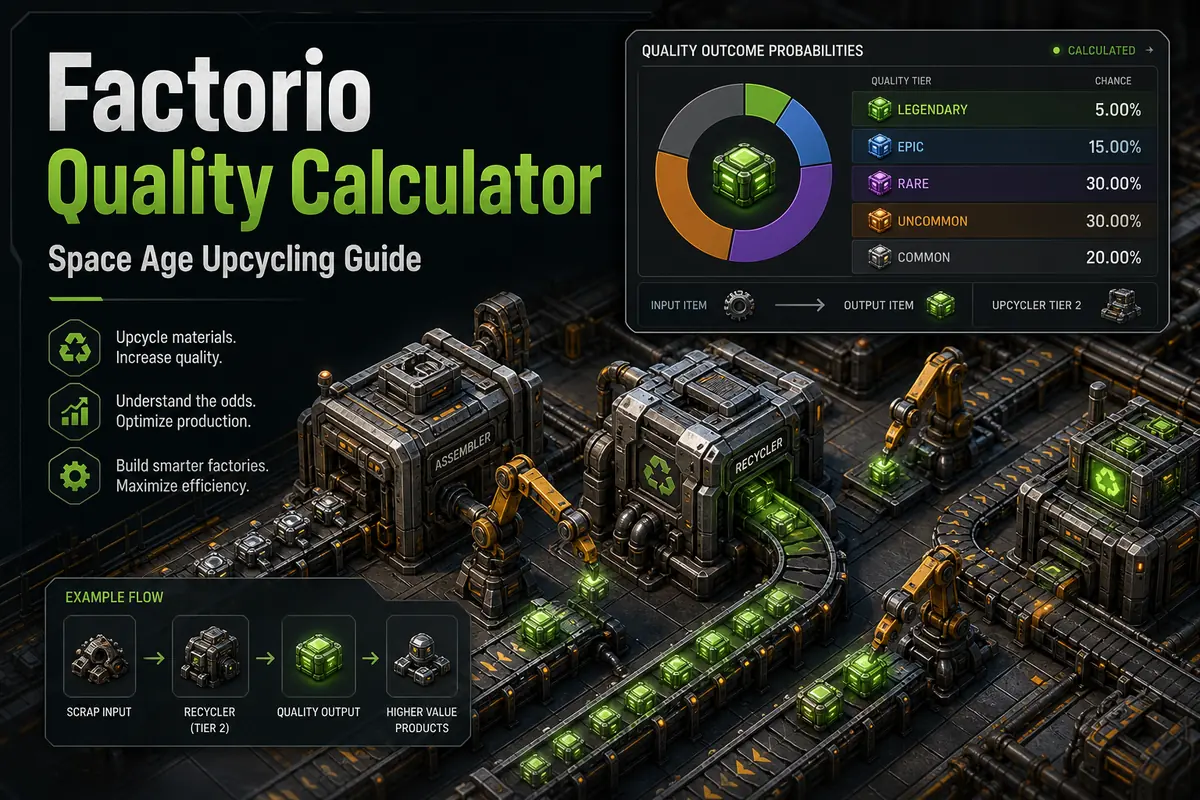
Quality Tiers and What Changes in the Math
Space Age quality adds five item tiers. Normal items behave like classic Factorio items. Higher tiers can improve many item stats, but the chance of getting them depends on quality modules and the recipe path.
| Tier | Planning Meaning | Calculator Impact |
|---|---|---|
| Normal | The baseline item quality used by standard production chains. | Use ordinary production rates unless the item enters a quality loop. |
| Uncommon | The first upgraded tier and usually the first sign a quality loop is working. | Often appears often enough to buffer directly or recycle failed outputs. |
| Rare | A mid-tier output where direct production starts needing more input volume. | Expected output should be calculated over time, not judged from short runs. |
| Epic | A high tier that usually benefits from looped recycling and strong modules. | Machine count, recycler count, and input replacement rate become important. |
| Legendary | The top target for expensive equipment, modules, armor, and selected infrastructure. | Plan by expected value and resource budget, not by a fixed build ratio. |
The Core Quality Calculator Formula
For a practical estimate, start with the target output rate, then multiply by the inverse of the expected success rate. A real calculator can do this across several tiers and loops, but the mental model is simple.
required attempts = target high-quality items / expected chance per attempt
replacement input = required attempts * net input lost after recycling
This is an estimate, not a guarantee for a single short production run. Over a long enough run, expected output becomes more useful for planning belts, buffers, and machine counts.
Quality Modules, Productivity and Recyclers
The most common planning mistake is treating quality as one extra multiplier. In practice, the setup has at least three moving parts.
Quality Modules
Quality modules add a chance for higher-quality output, but they also change machine speed. The right calculator view should show both item quality distribution and throughput.
Productivity Effects
Productivity can reduce raw input pressure, but it may not apply everywhere. Check the recipe and machine rules before assuming a productivity bonus is available.
Recycler Returns
Recycler loops convert unwanted outputs back into ingredients, but not all value returns. Fluid ingredients are not recovered, and most item recovery should be treated as a partial return.
Two Practical Quality Calculation Examples
These examples show the planning process without pretending there is one universal perfect ratio. The actual numbers should be recalculated for your machine tier, module layout, and recipe path.
Example 1: Legendary equipment or modules
- Choose the target item and target rate, such as one legendary module every few minutes.
- Calculate the base production chain first so normal ingredients are not the hidden bottleneck.
- Apply quality modules to the final craft or to earlier intermediate steps where it makes economic sense.
- Send non-target outputs into a recycler loop if the item can be upcycled efficiently.
- Size buffers and input belts for average demand plus variance, because short runs can be streaky.
Example 2: Quality accumulators for Space Age power builds
- Start with the power problem: how many accumulators are needed on the planet or platform?
- Decide whether higher quality meaningfully reduces footprint or logistics pressure.
- Calculate normal accumulator production, then add the quality loop only for the final target tier.
- Keep normal power ratios separate from quality math so the production line is easier to debug.
- Use a calculator when modules, beacons, and recycler loops all appear in the same plan.
Common Mistakes When Using a Factorio Quality Calculator
| Mistake | Why It Breaks the Plan | Better Approach |
|---|---|---|
| Using one fixed ratio for quality output | Quality is probability-based, so short runs can produce uneven results. | Plan by expected value and use buffers. |
| Ignoring recycler loss | A loop that looks free can still consume large amounts of replacement input. | Track net input consumed after recycling. |
| Mixing Space Age and vanilla assumptions | Space Age adds quality, planets, recyclers, and new machine contexts. | Label the game version and expansion assumptions clearly. |
| Optimizing every item for legendary quality | Many items are not worth the extra resources or complexity. | Reserve high quality for items with meaningful stat gains or logistic value. |
| Forgetting throughput | A mathematically correct loop can stall if inserters, belts, or recyclers cannot keep up. | Check items per second as well as quality chance. |
Recommended Workflow
Set the target tier
Decide whether you actually need uncommon, rare, epic, or legendary output. The higher the target, the more important expected-value planning becomes.
Calculate the normal chain
Use the Factorio calculator for the ordinary recipe chain before adding quality. This exposes raw material, belt, power, and intermediate bottlenecks.
Add quality modules where they matter
Test quality on the final item and on selected intermediates. Do not assume every earlier recipe is worth quality-moduling.
Model recycler loops
Account for partial returns, lost fluids, machine speed, and extra logistics. This is where many legendary-item plans become more expensive than expected.
Build with buffers
Quality output varies. Buffers prevent a few unlucky cycles from stalling downstream builds or giving a misleading short-term rate.
Need the full production chain first?
Use the homepage calculator for recipe chains, then return to this guide when quality modules and recycler loops become the main planning problem.
Factorio Quality Calculator FAQ
What is a Factorio quality calculator?
A Factorio quality calculator estimates expected output by quality tier after quality modules, crafting attempts, recycling loops, and replacement input are considered. It is most useful for Space Age items where uncommon, rare, epic, or legendary output matters.
Is quality calculation the same as a Factorio ratio calculator?
No. A ratio calculator balances recipe rates and machine counts. A quality calculator also needs probability, recycler returns, loop losses, and target-tier output estimates.
Should I make every item legendary in Space Age?
Usually no. Legendary quality is best reserved for items where the stat improvement, footprint reduction, or logistic advantage justifies the extra resources and machine complexity.
Do quality modules change production rates?
Yes. Quality modules affect the chance of higher-quality output and can also affect crafting speed. A useful calculator should show both expected quality distribution and throughput.
How do recycler loops affect legendary item planning?
Recycler loops let you retry unwanted outputs, but they do not make production free. You still need to account for partial returns, lost ingredients, lost fluids, machine throughput, and variance.
When should I use FactorioLab for quality planning?
Use FactorioLab or another live Factorio calculator when your plan includes several recipes, modules, beacons, Space Age machines, planet-specific logistics, or recycler loops. Manual math is best for understanding the shape of the problem.
Sources and Further Reading
Use current official and tool references when checking exact Space Age mechanics, because quality-related assumptions can change with game updates.