Guía de planos de trenes en Factorio: elige libros de vías que no se atasquen después
Los planos de trenes de Factorio ahorran horas, pero un libro de vías bonito puede bloquearse cuando llegan trenes reales, búferes de estación y tráfico de Space Age. Usa esta guía para elegir estaciones, apartaderos, cruces y libros de vías por longitud de tren, seguridad de señales y rendimiento. Antes de usar un libro, comprueba la longitud del tren, la separación de estaciones, las señales de las intersecciones y si el diseño se puede repetir.
Actualizado: 13 de agosto de 2026. Para Factorio 2.0, redes de Space Age y libros de blueprints importados.
Respuesta rápida: ¿qué planos de trenes conviene usar?
Usa un libro pequeño y coherente que coincida con la longitud de tus trenes y tu estilo de estación. Empieza con rectas, cruces en T, cruces de cuatro vías, estaciones de carga/descarga y un apartadero probado.
- Elige primero la longitud del tren: 1-2, 1-4, 2-4 y trenes mayores necesitan huellas distintas.
- Prefiere libros con señales normales, señales en cadena y variantes de estación a izquierda y derecha.
- Separa estaciones, apartaderos, cruces y depósitos en piezas reutilizables.
- Importa cadenas solo de fuentes que indiquen versión, orientación y tamaño previsto del tren.
- Haz una prueba de tráfico antes de usar el libro en una megabase o red de Space Age.
Un plano de tren es un sistema de vías, no un sello aislado
Un conjunto útil combina estaciones que encajan con el tren, cruces que se despejan rápido, apartaderos fuera de la línea principal y señales que evitan rutas conflictivas.
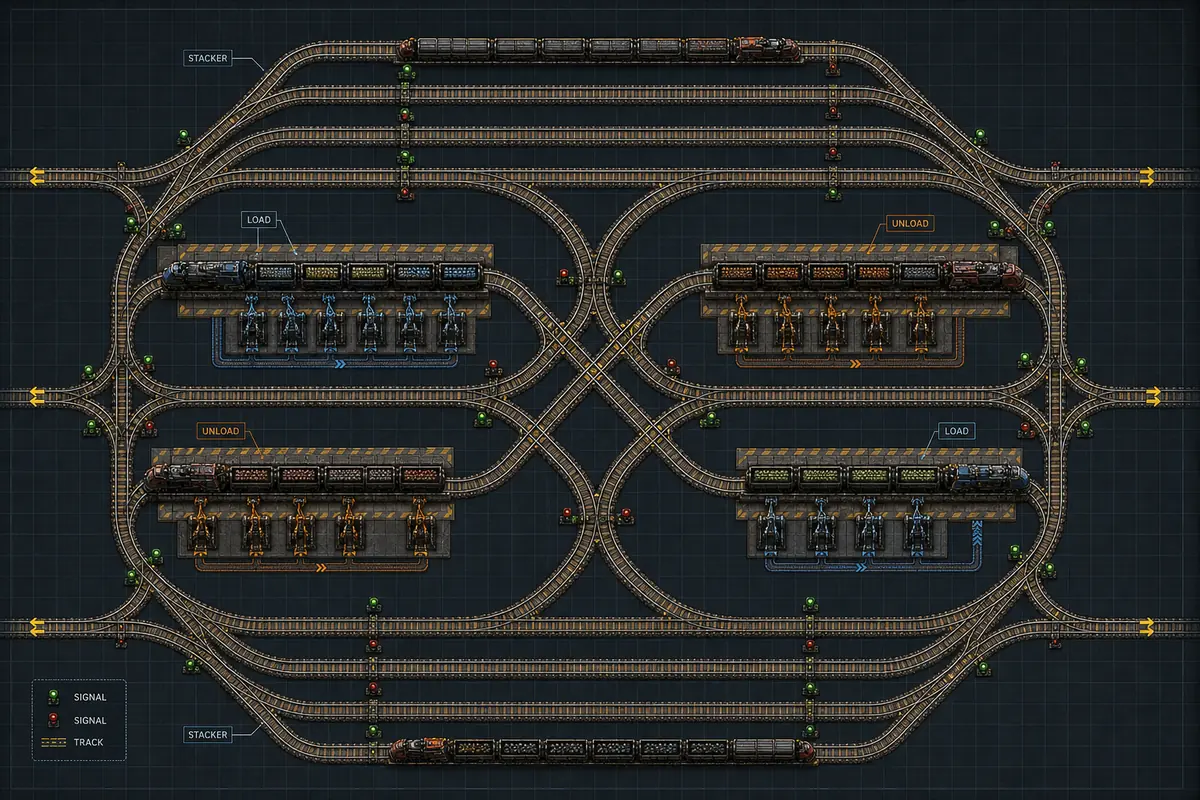
Factorio Train Blueprint Types and When to Use Them
Similarweb data shows demand for train blueprint books, rail blueprints and train-specific blueprint searches. Those are related, but they do not all deserve separate pages: the useful decision is which blueprint type solves the player problem.
| Blueprint type | Best use | What to verify before import |
|---|---|---|
| Straight rail and corners | Building the repeatable rail grid backbone | Rail spacing, drive side, power pole placement and chunk alignment |
| T-junctions and four-way intersections | Connecting outposts, city blocks and main lines | Chain signals before conflict points and normal signals after exits |
| Load and unload stations | Moving ore, plates, circuits, science or Space Age cargo | Train length, inserter lanes, buffers, belt output and station limits |
| Stackers and depots | Keeping waiting trains off the main line | Queue length, exit priority, signal blocks and bypass lanes |
| Blueprint books | A complete reusable rail standard | Version, train length, orientation variants and whether every piece aligns |
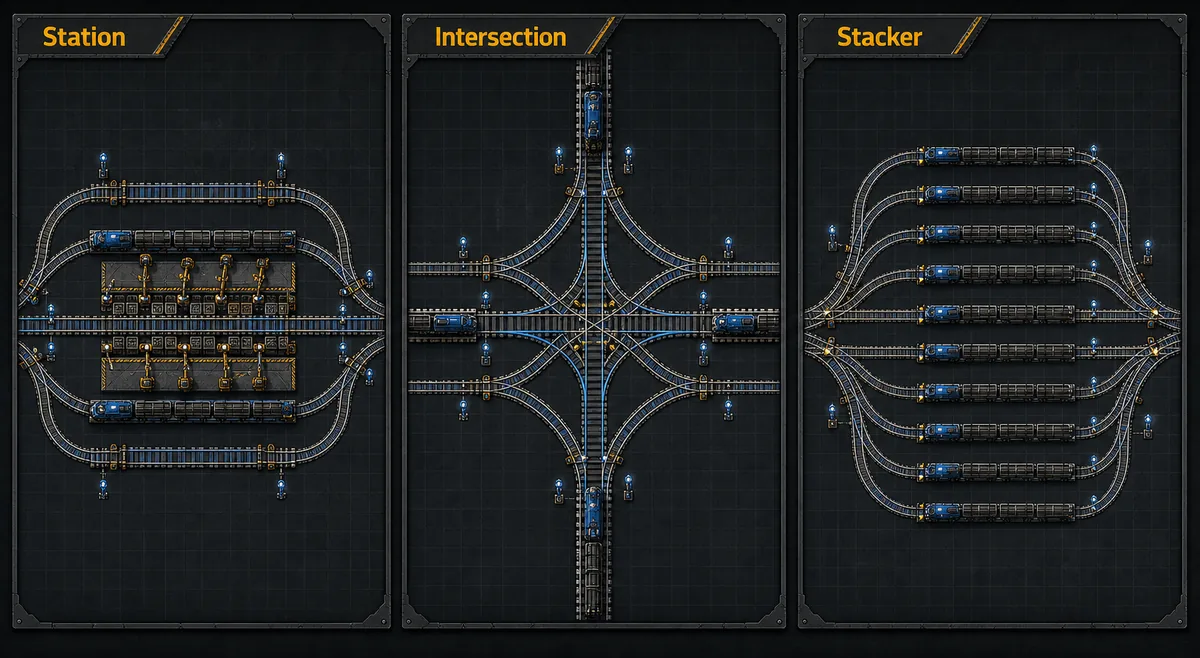
How to Choose a Factorio Train Blueprint Book
A good train blueprint book is boring in the best way: each piece snaps to the next, signals follow the same rule and every station fits the same train. Reject books that hide the assumptions you need to build around.
Train length match
Check whether the book was built for 1-2, 1-4, 2-4 or another train standard. A station made for 1-4 trains may break when a 2-4 train blocks the exit signal.
Signal rule consistency
Look for chain signals before crossings and normal rail signals after exits. Mixed or missing signal logic is the fastest path to deadlocks.
Station direction variants
Useful books include left/right or mirrored loading and unloading stations. Without variants, players often twist rails into awkward crossings.
Stacker separation
Busy stations need waiting lanes that do not block the through route. A blueprint with no stacker plan can work early and fail later.
Space Age compatibility
Factorio 2.0 and Space Age bases may use elevated rails, new production density and planet-specific logistics. Check whether the blueprint assumes older rail habits.
Testable module size
Choose pieces small enough to test in isolation. If the book only works as a huge city grid, debugging one bad signal becomes slow.
How to Import Blueprints in Factorio Without Breaking the Rail Network
The question keyword "how to import blueprints Factorio" is useful, but it is a supporting task inside the train-blueprint journey rather than a standalone page for this site. Put the import step near the blueprint selection advice.
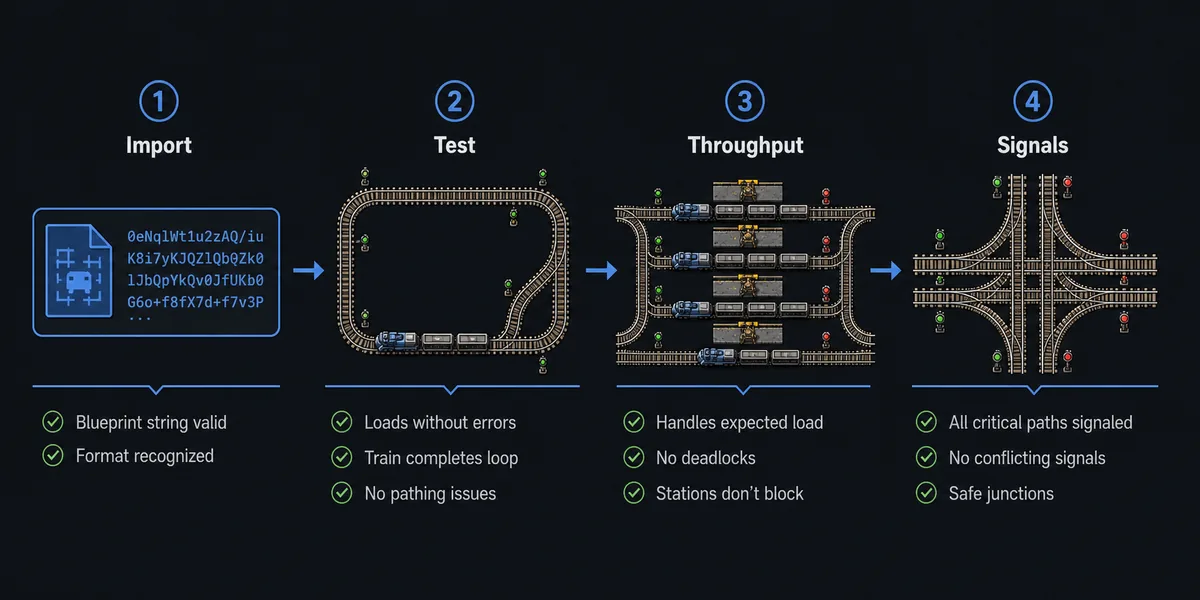
Copy the blueprint string
Use a trusted blueprint source and copy the full string. If the source does not mention Factorio version, train length or mods, treat it as a starting point rather than a guaranteed solution.
Import into a test save
Open the blueprint library, import the string and place the book in a sandbox or creative test area first. Avoid importing directly into a live rail network.
Check rails, signals and stations
Inspect every junction, station and stacker for broken alignment, missing signals, wrong train length and blocked station exits.
Run real trains through it
Send at least two loaded trains through adjacent stations and intersections. Watch whether a waiting train blocks the main line or creates a circular wait.
Save your edited version
After fixing orientation, signals and station limits, save the cleaned book as your base standard so future stamps stay consistent.
Station, Stacker and Signal Tests Before You Scale
Train blueprint pages often show attractive rail books but skip the operational checks. These tests are where a guide can add value beyond a raw blueprint string.
| Test | Pass condition | Why it matters |
|---|---|---|
| Station exit test | A full train can leave without blocking another train entering or passing through | Prevents station queues from freezing the main line |
| Intersection conflict test | Chain signals hold trains before the crossing, and exits clear into normal signal blocks | Prevents deadlocks at four-way and T-junctions |
| Stacker capacity test | The expected number of trains can wait entirely off the main rail | Keeps high-demand stations from stopping unrelated routes |
| Throughput test | Unload belts, inserters or bots can empty wagons before the next train arrives | Makes the blueprint match production demand, not just rail geometry |
| Expansion test | The next station or block can snap without rotating the whole design | Protects long-term city block and outpost growth |
Where to Find Factorio Train Blueprints Safely
For this site, the page should not become an unverified blueprint dump. It should teach readers how to evaluate sources and then point them to places where they can inspect version notes, comments and blueprint strings themselves.
Factorio Prints and similar libraries
Good for browsing many rail books, but check comments, update dates, version notes and whether the design fits your train size.
Forum and Reddit rail books
Useful when the author explains the rail standard and traffic assumptions. Treat old threads as ideas to test, not current rules.
GitHub blueprint collections
Helpful when a rail book has documentation, changelog and structured versions. Still test imports because mod sets and rail habits vary.
Your own edited book
The safest final source is a book you imported, tested, fixed and saved for your base standard.
Common Train Blueprint Mistakes
| Mistake | Symptom | Better choice |
|---|---|---|
| Importing a huge book without choosing train length | Stations do not fit, or exits are blocked by longer trains | Choose the train standard first, then select compatible blueprints |
| Using intersections without understanding signals | Trains stop inside crossings and block each other | Use chain signals before conflicts and rail signals after clear exits |
| No stacker for busy unload stations | Trains wait on the main line and block unrelated traffic | Add a stacker or reduce station train limits |
| Mixing different rail spacings | Blueprint pieces stop snapping cleanly | Use one rail standard per base area |
| Trusting old blueprint strings blindly | Recipes, rails or Space Age logistics assumptions no longer fit | Check version notes and test in a sandbox save |
¿Necesitas dimensionar la ruta detrás del plano?
Usa la calculadora de trenes de Factorio para estimar el rendimiento de vagones y decidir si la estación necesita más vagones, descarga más rápida, un apartadero mayor o otro diseño ferroviario.
Preguntas frecuentes sobre planos de trenes en Factorio
¿Cuáles son los mejores planos de trenes en Factorio?
Los mejores son los que coinciden con tu longitud de tren, separación de vías y estilo de estación. Un libro pequeño con estaciones, apartaderos, cruces y señales probadas suele ser más seguro que un libro enorme sin probar.
¿Dónde encuentro libros de planos de trenes?
Puedes revisar Factorio Prints, FactorioBin, foros, Reddit y colecciones de GitHub. Comprueba versión, comentarios y longitud prevista del tren antes de importar.
¿Cómo importo planos en Factorio?
Copia la cadena, abre la biblioteca de planos del juego, usa importar cadena y colócala primero en una partida de prueba.
¿Conviene usar trenes 1-4 o 2-4?
Usa 1-4 para estaciones compactas y expansión temprana. Usa 2-4 o más cuando necesites más carga y tengas espacio para estaciones y apartaderos largos.
¿Por qué se bloquean los planos importados?
Suele deberse a señales en cadena ausentes, salidas cortas, apartaderos en la línea principal, estándares mezclados o trenes más largos que la estación.
¿Space Age necesita planos distintos?
A menudo sí. Space Age cambia densidad y logística, y algunos libros antiguos no encajan con Factorio 2.0.
¿Cómo pruebo un blueprint de intersección de trenes de Factorio?
Prueba la intersección con el tren más largo que vayas a usar, señales de cadena en la entrada y señales normales en las salidas. Un blueprint ferroviario repetible solo es seguro cuando los trenes cargados y vacíos pasan sin bloquear la entrada de la estación.
Fuentes y lecturas recomendadas
Estas referencias ayudan a verificar mecánicas de vías, paradas, señales y blueprints antes de usar un libro importado.