Factorio Zug-Blueprints: Schienenbücher wählen, die später nicht blockieren
Factorio Zug-Blueprints sparen Zeit, aber ein sauberes Schienenbuch kann mit echten Zügen, Bahnhofs-Puffern und Space-Age-Verkehr trotzdem blockieren. Entscheide nach Zuglänge, Signalen und Durchsatz. Prüfe bei jedem Buch Zuglänge, Bahnhofsabstand, Signale an Kreuzungen und ob das Layout kachelbar ist, bevor du es im aktiven Netz platzierst.
Aktualisiert am 13.08.2026. Für Factorio 2.0, Space Age und importierte Blueprint-Bücher.
Kurzantwort: Welche Zug-Blueprints solltest du nutzen?
Nutze ein kleines, einheitliches Schienenbuch, das zu Zuglänge und Bahnhofsstil passt. Teste Geraden, T-Kreuzungen, Vier-Wege-Kreuzungen, Ladebahnhöfe und Stacker zuerst.
- Lege zuerst die Zuglänge fest: 1-2, 1-4, 2-4 und größere Züge brauchen andere Flächen.
- Bevorzuge Bücher mit Signalen, Kettensignalen und linken/rechten Bahnhofvarianten.
- Trenne Bahnhöfe, Stacker, Kreuzungen und Depots in wiederverwendbare Module.
- Importiere Strings nur aus Quellen mit Version, Ausrichtung und vorgesehener Zuggröße.
- Teste den Verkehr, bevor du das Buch in Megabase oder Space Age nutzt.
Zug-Blueprints sind ein Schienensystem, kein einzelner Stempel
Ein brauchbares Set enthält passende Bahnhöfe, schnell räumende Kreuzungen, Stacker abseits der Hauptlinie und sichere Signale.
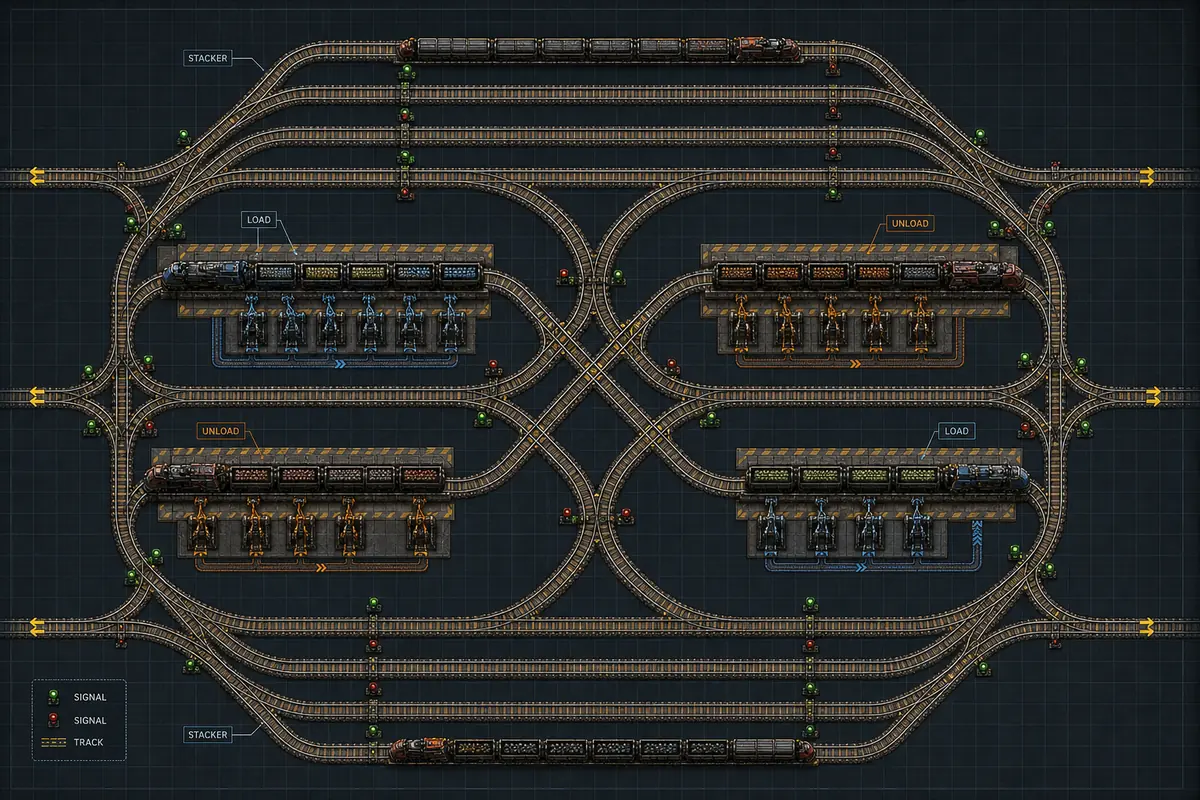
Factorio Train Blueprint Types and When to Use Them
Similarweb data shows demand for train blueprint books, rail blueprints and train-specific blueprint searches. Those are related, but they do not all deserve separate pages: the useful decision is which blueprint type solves the player problem.
| Blueprint type | Best use | What to verify before import |
|---|---|---|
| Straight rail and corners | Building the repeatable rail grid backbone | Rail spacing, drive side, power pole placement and chunk alignment |
| T-junctions and four-way intersections | Connecting outposts, city blocks and main lines | Chain signals before conflict points and normal signals after exits |
| Load and unload stations | Moving ore, plates, circuits, science or Space Age cargo | Train length, inserter lanes, buffers, belt output and station limits |
| Stackers and depots | Keeping waiting trains off the main line | Queue length, exit priority, signal blocks and bypass lanes |
| Blueprint books | A complete reusable rail standard | Version, train length, orientation variants and whether every piece aligns |
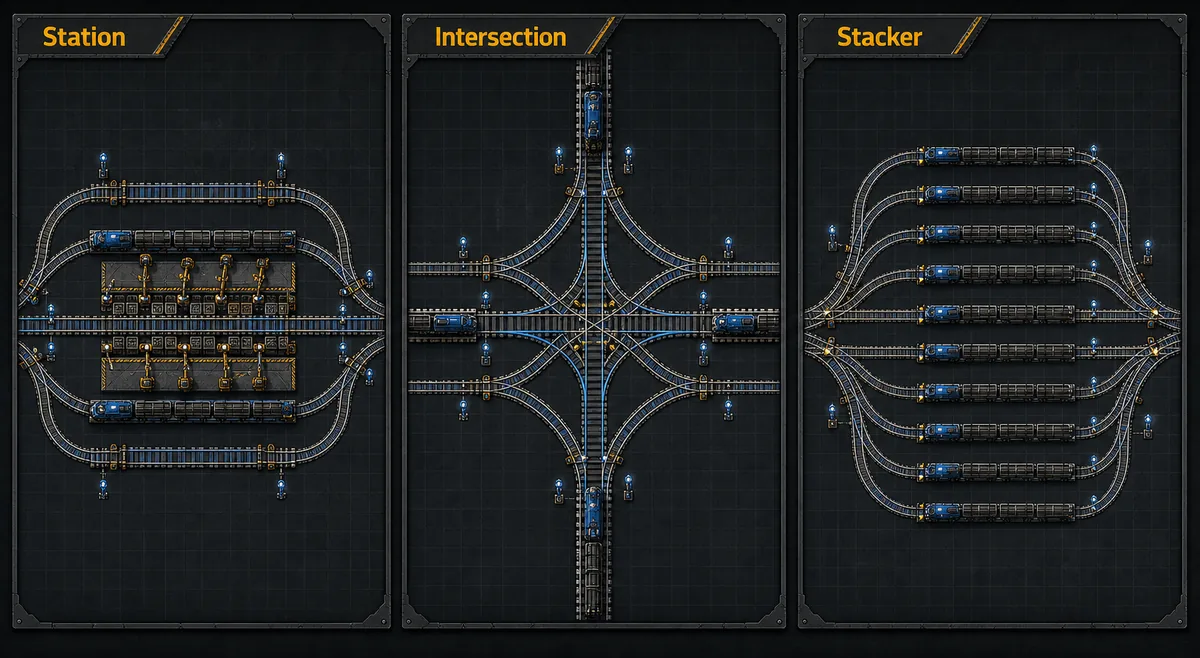
How to Choose a Factorio Train Blueprint Book
A good train blueprint book is boring in the best way: each piece snaps to the next, signals follow the same rule and every station fits the same train. Reject books that hide the assumptions you need to build around.
Train length match
Check whether the book was built for 1-2, 1-4, 2-4 or another train standard. A station made for 1-4 trains may break when a 2-4 train blocks the exit signal.
Signal rule consistency
Look for chain signals before crossings and normal rail signals after exits. Mixed or missing signal logic is the fastest path to deadlocks.
Station direction variants
Useful books include left/right or mirrored loading and unloading stations. Without variants, players often twist rails into awkward crossings.
Stacker separation
Busy stations need waiting lanes that do not block the through route. A blueprint with no stacker plan can work early and fail later.
Space Age compatibility
Factorio 2.0 and Space Age bases may use elevated rails, new production density and planet-specific logistics. Check whether the blueprint assumes older rail habits.
Testable module size
Choose pieces small enough to test in isolation. If the book only works as a huge city grid, debugging one bad signal becomes slow.
How to Import Blueprints in Factorio Without Breaking the Rail Network
The question keyword "how to import blueprints Factorio" is useful, but it is a supporting task inside the train-blueprint journey rather than a standalone page for this site. Put the import step near the blueprint selection advice.
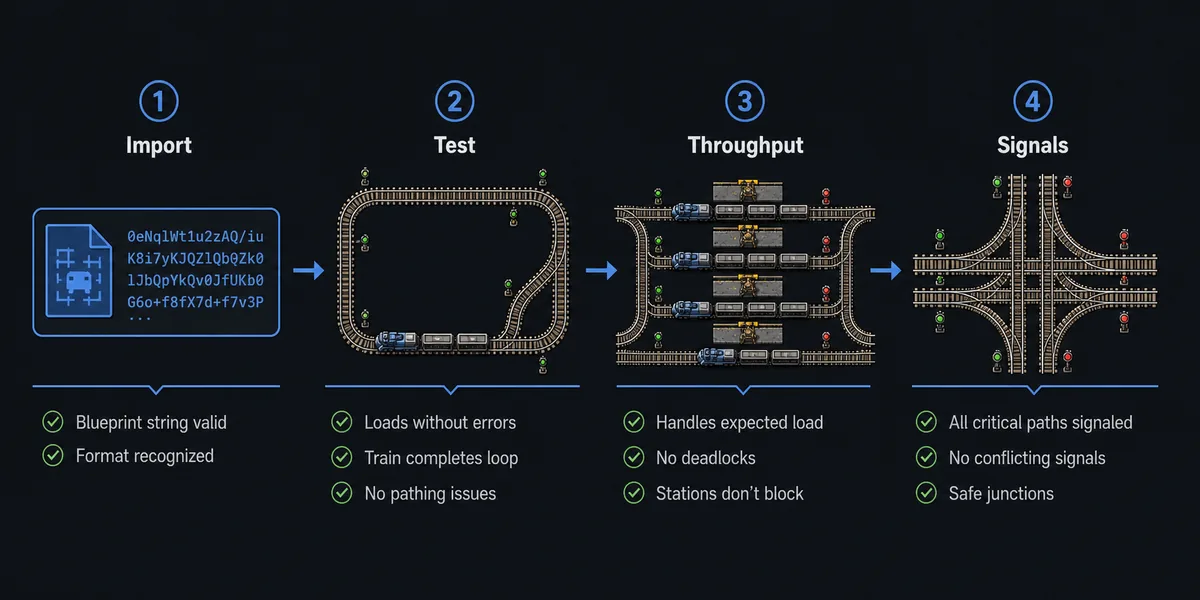
Copy the blueprint string
Use a trusted blueprint source and copy the full string. If the source does not mention Factorio version, train length or mods, treat it as a starting point rather than a guaranteed solution.
Import into a test save
Open the blueprint library, import the string and place the book in a sandbox or creative test area first. Avoid importing directly into a live rail network.
Check rails, signals and stations
Inspect every junction, station and stacker for broken alignment, missing signals, wrong train length and blocked station exits.
Run real trains through it
Send at least two loaded trains through adjacent stations and intersections. Watch whether a waiting train blocks the main line or creates a circular wait.
Save your edited version
After fixing orientation, signals and station limits, save the cleaned book as your base standard so future stamps stay consistent.
Station, Stacker and Signal Tests Before You Scale
Train blueprint pages often show attractive rail books but skip the operational checks. These tests are where a guide can add value beyond a raw blueprint string.
| Test | Pass condition | Why it matters |
|---|---|---|
| Station exit test | A full train can leave without blocking another train entering or passing through | Prevents station queues from freezing the main line |
| Intersection conflict test | Chain signals hold trains before the crossing, and exits clear into normal signal blocks | Prevents deadlocks at four-way and T-junctions |
| Stacker capacity test | The expected number of trains can wait entirely off the main rail | Keeps high-demand stations from stopping unrelated routes |
| Throughput test | Unload belts, inserters or bots can empty wagons before the next train arrives | Makes the blueprint match production demand, not just rail geometry |
| Expansion test | The next station or block can snap without rotating the whole design | Protects long-term city block and outpost growth |
Where to Find Factorio Train Blueprints Safely
For this site, the page should not become an unverified blueprint dump. It should teach readers how to evaluate sources and then point them to places where they can inspect version notes, comments and blueprint strings themselves.
Factorio Prints and similar libraries
Good for browsing many rail books, but check comments, update dates, version notes and whether the design fits your train size.
Forum and Reddit rail books
Useful when the author explains the rail standard and traffic assumptions. Treat old threads as ideas to test, not current rules.
GitHub blueprint collections
Helpful when a rail book has documentation, changelog and structured versions. Still test imports because mod sets and rail habits vary.
Your own edited book
The safest final source is a book you imported, tested, fixed and saved for your base standard.
Common Train Blueprint Mistakes
| Mistake | Symptom | Better choice |
|---|---|---|
| Importing a huge book without choosing train length | Stations do not fit, or exits are blocked by longer trains | Choose the train standard first, then select compatible blueprints |
| Using intersections without understanding signals | Trains stop inside crossings and block each other | Use chain signals before conflicts and rail signals after clear exits |
| No stacker for busy unload stations | Trains wait on the main line and block unrelated traffic | Add a stacker or reduce station train limits |
| Mixing different rail spacings | Blueprint pieces stop snapping cleanly | Use one rail standard per base area |
| Trusting old blueprint strings blindly | Recipes, rails or Space Age logistics assumptions no longer fit | Check version notes and test in a sandbox save |
Musst du die Zugroute hinter dem Blueprint dimensionieren?
Nutze den Factorio-Zugrechner, um Waggon-Durchsatz zu schätzen und zu entscheiden, ob mehr Waggons, schnelleres Entladen, ein größerer Stacker oder ein anderes Layout nötig ist.
FAQ zu Factorio Zug-Blueprints
Was sind die besten Factorio Zug-Blueprints?
Die besten passen zu Zuglänge, Gleisabstand und Bahnhofsstil. Ein kleines getestetes Buch mit Bahnhöfen, Stackern, Kreuzungen und Signalen ist sicherer als ein riesiges ungetestetes Buch.
Wo finde ich Zug-Blueprint-Bücher?
Prüfe Factorio Prints, FactorioBin, Foren, Reddit und GitHub-Sammlungen. Achte auf Version, Kommentare und vorgesehene Zuglänge.
Wie importiere ich Blueprints in Factorio?
Kopiere den String, öffne die Blueprint-Bibliothek, importiere den String und platziere ihn zuerst in einem Teststand.
Soll ich 1-4 oder 2-4 Züge nutzen?
1-4 ist kompakter und gut für frühe Skalierung. 2-4 oder größer eignet sich für mehr Massendurchsatz, braucht aber längere Bahnhöfe und Stacker.
Warum deadlocken importierte Zug-Blueprints?
Häufige Ursachen sind fehlende Kettensignale, zu kurze Ausfahrten, Stacker auf der Hauptlinie, gemischte Standards oder zu lange Züge.
Brauchen Space-Age-Basen andere Blueprints?
Oft ja. Space Age ändert Produktionsdichte und Logistik, und ältere Bücher passen nicht immer zu Factorio 2.0.
Wie teste ich einen Factorio-Blueprint für eine Zugkreuzung?
Teste die Kreuzung mit dem längsten geplanten Zug, Kettensignalen an den Zufahrten und normalen Signalen an den Ausfahrten. Ein kachelbarer Schienen-Blueprint ist erst sicher, wenn beladene und leere Züge den Bahnhofsbereich ohne Blockade passieren.
Quellen und weitere Lektüre
Diese Referenzen helfen, Schienen, Haltestellen, Signale und Blueprint-Verhalten vor dem Import zu prüfen.