Factorio Circuit Network Guide: Wires, Combinators & Automation
A Factorio circuit network is a small control system: a device publishes a signal, wires carry it, and a condition changes the next machine. Start with one chest and one inserter, verify the signal, then add combinators only when a direct condition is not enough. This guide covers red and green wires, arithmetic and decider combinators, pumps, belts, lamps, trains and reliable debugging.
Last updated: October 12, 2026. Written for Factorio 2.0 and Space Age circuit networks.
Quick Answer: How Does a Factorio Circuit Network Work?
Connect compatible entities with a red or green wire, choose what each entity reads or writes, and add a condition that turns the signal into an action. Red and green networks stay separate until you combine them. Circuits add a programmable control layer; they do not replace logistics or safe rail design.
- Use red and green wires as two independent signal channels. Keep them separate when you want two conditions to remain distinct.
- Read a chest, belt, tank or accumulator to publish its inventory or charge as a signal on the network.
- Set an inserter, pump, lamp, belt or train station to enable, disable, or change behavior when a condition is true.
- Use a constant combinator for fixed thresholds and a decider combinator for filters, comparisons, and one-signal outputs.
- Use an arithmetic combinator when you need to multiply, divide, add, subtract, or normalize a signal before making a decision.
Signals Become Actions Through a Simple Path
A reliable first circuit has a visible source, a short wire, one rule, and an obvious output. A chest can publish an item count, a combinator can compare it with a threshold, and an inserter or lamp can show the result. The diagram keeps those roles visible so you can trace a problem from source to machine.
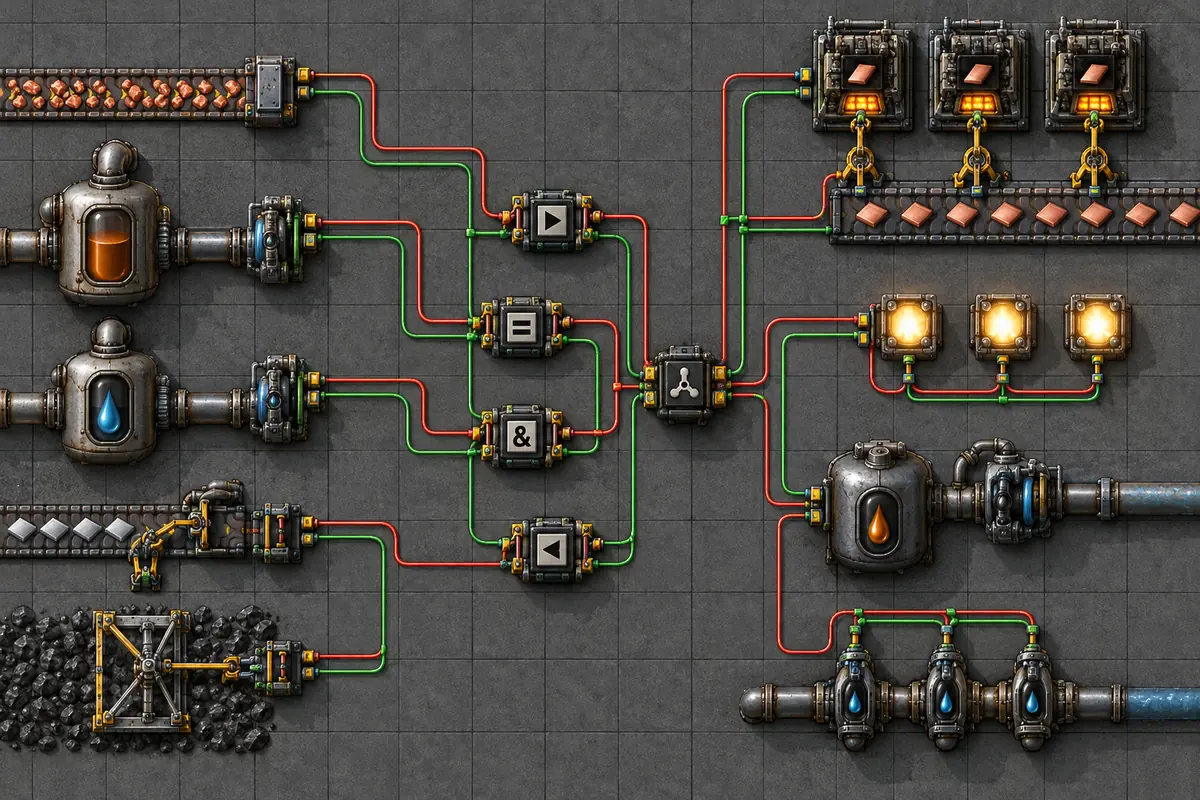
Factorio Circuit Network Basics: Signals, Wires and Reading Modes
A circuit network is a shared set of signal values. Connected entities can read, write, or do both. Decide which entity owns each signal, which entity consumes it, and whether another source could overwrite the value.
| Network part | What it provides | Good first use |
|---|---|---|
| Red wire | One independent channel of item, fluid, virtual, or control signals | Connect a chest to an inserter without mixing it with a second rule |
| Green wire | A second independent channel that can carry the same signal names | Keep a safety condition separate from a production threshold |
| Signal source | Inventory, fluid level, belt contents, energy, train state, or a fixed constant | Read a chest or tank before controlling a machine |
| Signal consumer | An inserter, pump, lamp, belt, train stop, or other controllable entity | Enable an inserter when iron plates fall below a limit |
| Condition | A comparison or arithmetic result that selects the next action | Enable when iron plates < 200 and disable when the stock is restored |
Arithmetic, Decider and Constant Combinators
Combinators are processing steps between a source and a machine. Use the smallest one that expresses the rule: constant for fixed values, arithmetic for transformations, and decider for comparisons or filters.
Constant combinator
Use it for a threshold, recipe choice, train limit, or other value that should not depend on inventory. It is also a useful label for a network: publish a single virtual signal that tells the rest of the build what the circuit is meant to control.
Arithmetic combinator
Use arithmetic when the raw signal is not in the form your machine needs. Multiply a count by a request size, divide a total into a rate, add two inventories, or negate a value before passing it to a later condition. Keep the output signal explicit so the next step is readable.
Decider combinator
Use a decider to compare one signal with another or with a constant, then output a selected signal when the condition is true. It is a good fit for low-stock alerts, inserter enable rules, pump priorities, and train station limits.
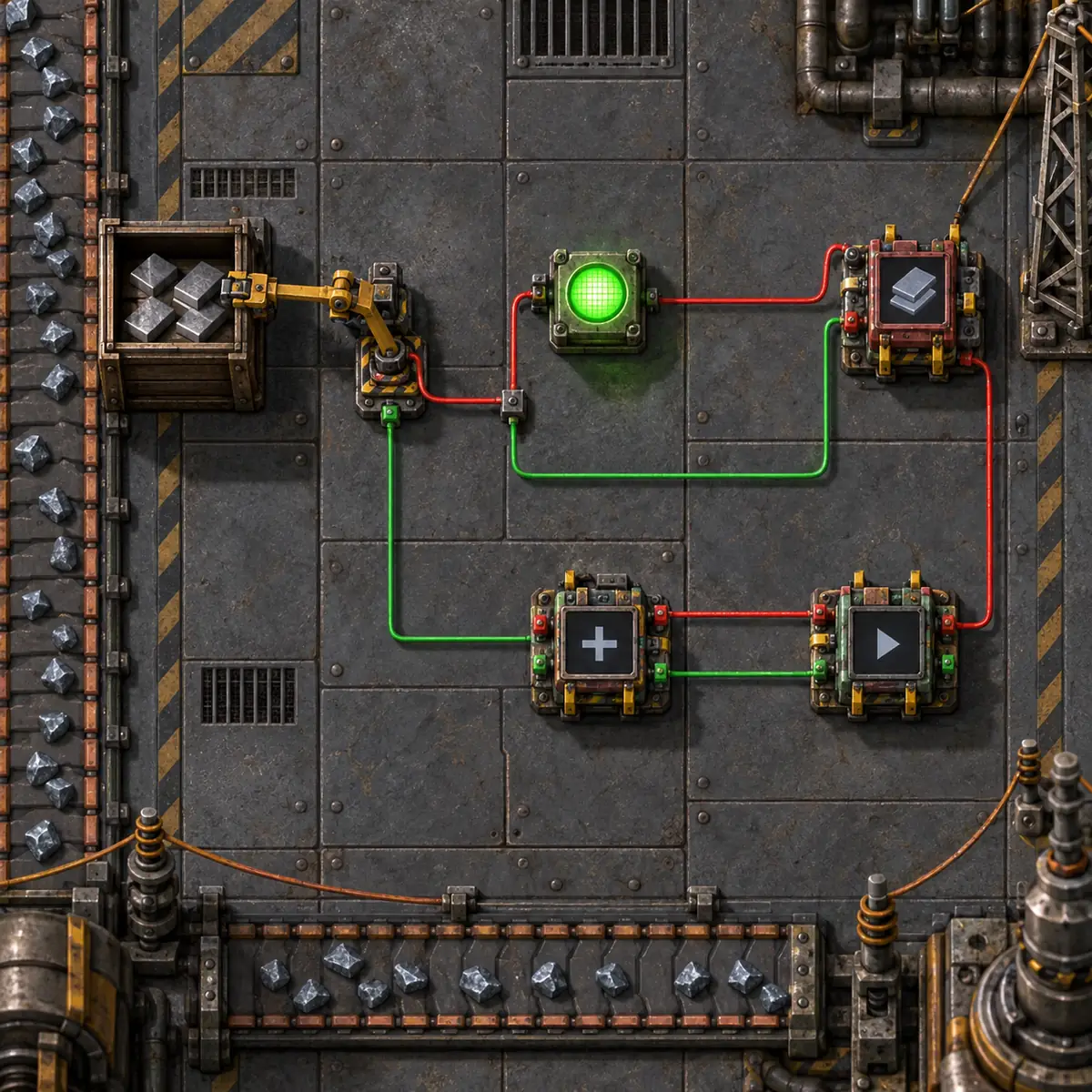
How to Build Your First Factorio Circuit Network
Use a test chest and spare inserter before touching production. This five-step process makes it clear which entity publishes the signal and which condition controls the output.
Choose one signal source
Place a chest, tank, belt segment, accumulator, or constant combinator that represents the fact you want to measure. Put a small amount of the relevant item or fluid in it so the signal is easy to recognize. Avoid starting with a whole storage block because several sources can publish the same signal at once.
Connect one wire channel
Use a red or green wire to connect the source to the target entity. Keep the other color disconnected while you test. Open both entities and confirm that the source is set to read the content you care about and that the target is set to read the circuit network.
Write one clear condition
Set a direct enable or disable rule such as iron plates less than 200. If the rule is difficult to describe in one sentence, split it into a source, an arithmetic step, and a decider step instead of hiding several ideas in one network.
Make the output visible
Use an inserter, lamp, pump, or belt as the first output. A lamp is useful during testing because it makes a true condition obvious without changing your production. Change the chest contents and watch the signal and output change together.
Add a failure test
Test zero items, the exact threshold, a value above the threshold, and a disconnected wire. Also test what happens when two sources publish the same signal. Write down the expected result before adding a second rule or copying the circuit to a live line.
Useful Factorio Circuit Network Automation Examples
Circuits are valuable when they stop a shortage or surplus from spreading. These examples show where a direct condition is enough and where a combinator makes the rule clearer.
Low-stock inserter
Connect a provider or buffer chest to an inserter and enable it while the requested item is below a threshold. This keeps a mall or outpost supplied without running the inserter continuously. If several chests are involved, decide whether the network should read each chest separately or publish a combined total.
Pump and oil cracking control
Read a fluid tank and enable a pump or cracking input when a fluid level crosses the chosen limit. Leave room for the machines downstream to consume the fluid; a rule that reacts at the exact full or empty point can make a system oscillate. A small hysteresis gap is easier to tune when the factory is busy.
Lamp status display
Connect a lamp to a storage, power, or production signal and use different lamps for different states. This creates a cheap dashboard for an outpost: one color for low ammunition, another for a full buffer, and a third for a train that has not arrived. Keep display circuits separate from control circuits when a mistake could stop production.
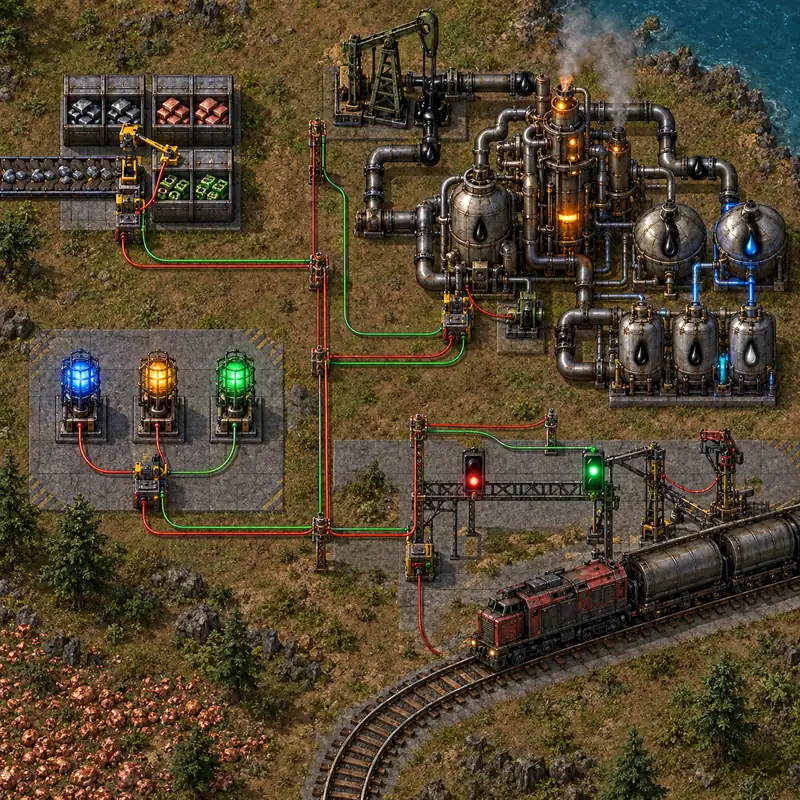
Factorio Circuit Network Troubleshooting Checklist
Inspect a circuit at each boundary instead of changing every condition. Start at the source, verify the wire color, then check the target read mode and comparison.
| Symptom | Likely cause | First check |
|---|---|---|
| The target never enables | The target is not reading the network or the wire is disconnected | Open the target and verify the read circuit setting and wire connection |
| A signal is always zero | The source reads the wrong inventory, fluid, or belt mode | Inspect the source read settings and compare with a known non-zero test |
| Red and green values seem mixed | Both channels are connected through another entity | Trace every connection and temporarily remove the second color |
| A lamp works but the inserter does not | The two entities use different conditions or signals | Copy the exact signal and comparison into the inserter condition |
| A pump flickers on and off | The threshold leaves no buffer for consumption timing | Add a wider gap between the enable and disable states |
| A train station stops the wrong route | The station demand signal is shared too broadly | Give the station a dedicated signal and keep train limits local |
Planning a circuit-controlled production line?
Use the Factorio ratios guide to estimate the production chain first, then add circuit conditions where storage, fluids, power, or train demand need a clear control rule.
Factorio Circuit Network FAQ
What is a circuit network in Factorio?
It is a signal system that lets connected entities read values, publish values, and change behavior when conditions are true. Wires carry item, fluid, energy, virtual, and control signals between machines.
What is the difference between red and green wires?
They are separate network channels. A device can read both, but a value on the red network does not automatically mix with the green network. Keeping colors separate is useful for independent rules.
Do I need a combinator for every circuit?
No. A chest, tank, or belt can connect directly to an inserter, pump, lamp, or station with a condition. Add a combinator when you need transformed values, multiple inputs, filtering, memory, or a reusable rule.
How do I make an inserter use a circuit condition?
Connect the source and inserter with a red or green wire, open the inserter, enable circuit reading, choose the signal, and set the comparison. Test the source at zero and above the threshold before using the rule in production.
Official Factorio Sources
These official Factorio Wiki pages document the circuit-network and combinator behavior used in this guide. Test every threshold in your own save because the factory layout and update version still affect the result.