Factorio Tech Tree Guide: Research Order, Science & Space Age
The Factorio tech tree is not just a list of unlocks. It is a planning map that connects science packs, production chains, power, oil, logistics and the next factory milestone. Use this guide to choose a practical research order without treating one fixed route as mandatory.
Last updated: August 6, 2026. Covers vanilla Factorio 2.0 and Space Age planning.
Quick Answer: What Does the Factorio Tech Tree Show?
The Factorio tech tree shows which technologies can be researched, which prerequisites and science packs they need, and what each unlock changes in your factory. The best next technology is the one that removes your current bottleneck or opens the next production step, not always the one with the cheapest research cost.
- Start with a factory goal such as automation, oil, robots, trains, modules or a Space Age planet.
- Check the prerequisite chain before committing labs, because one missing production block can delay the whole branch.
- Plan science pack production separately from the research queue; a visible technology unlock is useful only when your labs can sustain it.
- Pin or track the next item in the in-game technology view, then use a calculator for the ingredients, machines, belts and power behind that goal.
- Treat modded technology trees as separate data sets. A vanilla route should not be copied into Krastorio 2, Space Exploration or Pyanodons.
A Tech Tree Is a Factory Dependency Map
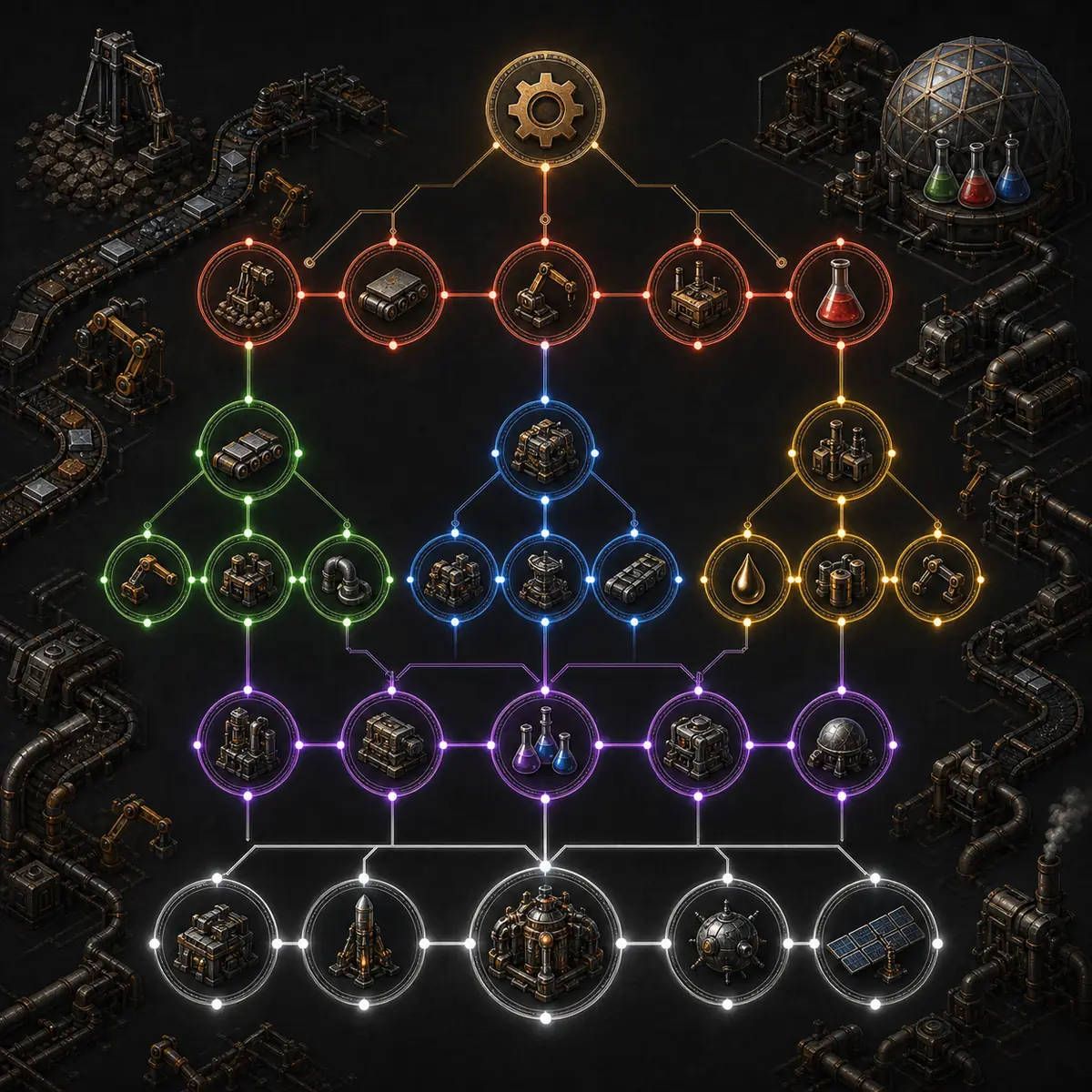
Each research node represents more than a button in the lab. It can add a machine, recipe, transport method, defense option or new production constraint. Reading the tree together with your current factory makes the next research choice easier to justify.
What the Factorio Tech Tree Actually Tells You
Open the technology screen whenever you need to decide what the factory should build next. Read each node as a small planning contract: it has a prerequisite, a science cost, a production consequence and a reason you might want it now.
| Tree signal | What to check | Why it matters |
|---|---|---|
| Prerequisite connection | Which earlier technology must be finished first? | A shortcut is impossible if the chain is not unlocked. |
| Science icons | Which packs and how many units are required? | The research queue can expose a missing science production line. |
| Unlock result | Does it add a recipe, machine, module, weapon or transport system? | The unlock may create new demand for oil, circuits, power or space. |
| Repeat level | Is it a one-time unlock or an infinite research level? | Infinite research is a long-run sink and should not block a needed factory milestone. |
| Pinned target | Can the next item be tracked while you build? | Tracking turns a broad tree into a concrete shopping and production list. |
A Practical Early-Game Research Order
There is no single best research order for every map. The sequence below is a stable default for a normal vanilla start; move a branch earlier when the map, enemy pressure or your factory goal makes it the real constraint.
| Stage | Typical focus | Planning question |
|---|---|---|
| 1. Automation | Assemblers and basic automation | Can the factory stop hand-crafting the items needed for research? |
| 2. Logistics and military | Belts, inserters, defenses and early combat support | Is the base safe and can materials move between production blocks? |
| 3. Steel and oil preparation | Steel, engines, sulfur and oil prerequisites | Do smelting and oil capacity support the next science pack? |
| 4. Chemical and production systems | Chemical science, production science, rails or modules | Which branch removes the largest current bottleneck? |
| 5. Utility and scaling | Robots, advanced modules, power and late-game logistics | Will the next unlock reduce manual work or unlock the target factory scale? |
How Science Packs Gate the Tech Tree
Research order and science production are coupled. When a new branch asks for a science pack you do not yet produce, the correct response is usually to plan that pack as a small factory project rather than repeatedly changing the research queue.
| Science gate | Typical dependency | What to plan before researching |
|---|---|---|
| Automation science | Early assemblers and simple intermediates | Reliable iron, copper, gears and transport. |
| Logistic science | Inserters, belts and expanded base logistics | Green circuits, iron throughput and enough assemblers. |
| Military science | Weapons, walls and defensive expansion | Grenades, ammunition, steel and a safe supply route. |
| Chemical science | Oil processing and many mid-game systems | Refineries, sulfur, plastic, petroleum gas and power. |
| Production science | Rails, advanced machines and modules | Stone, steel, circuits, electric furnaces and larger belts. |
| Utility and Space Age science | Robots, late-game logistics and expansion branches | Blue circuits, low density structures, rocket or planet logistics and stable power. |
How to Choose the Next Technology
When several nodes are available, compare their practical payoff instead of selecting only by science cost. The following workflow keeps research aligned with the factory you are actually building.
Name the next factory milestone
Write one concrete target: automate a product, sustain a science-per-minute rate, defend a frontier, connect a rail block, launch a rocket or reach a new planet.
Find the shortest useful branch
Look backward from the target and identify the prerequisite chain. A short branch that unlocks the needed machine is usually more valuable than a broad convenience upgrade.
Check the missing inputs
List the science packs and materials that will become bottlenecks. If the branch needs oil, circuits or power you do not have, plan those systems before the queue becomes a surprise.
Pin the research target
Keep the next technology visible while you build. Pinning is especially useful when a branch requires several intermediate items or when you are switching between research and construction tasks.
Recalculate after the unlock
A new machine tier, module, recipe or transport option changes production math. Recheck machine counts, belt demand, fluids and power before copying the old layout.
Space Age Tech Tree Planning
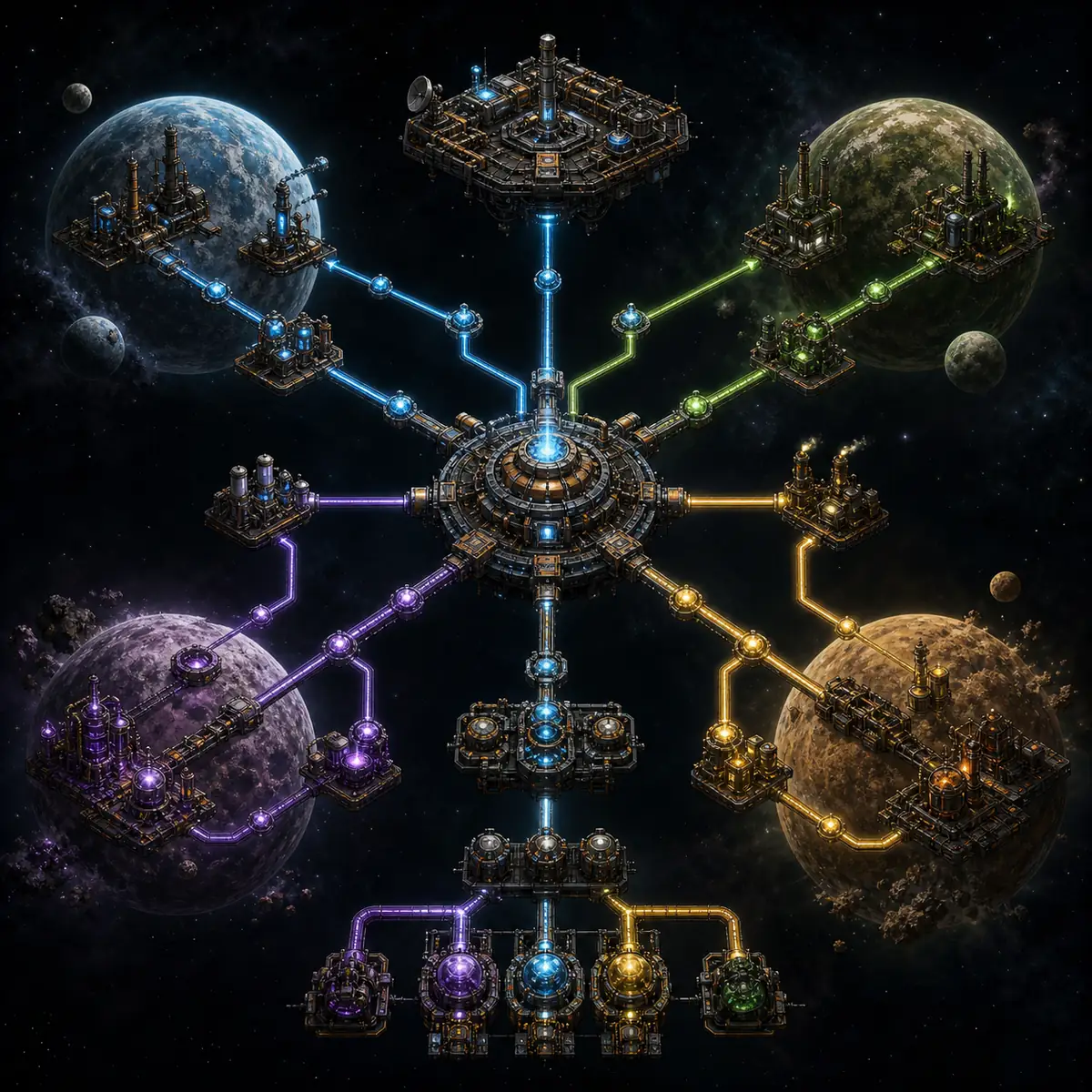
Space Age turns the research tree into a distributed planning problem. Planet access, science packs, local recipes, platform construction, spoilage and quality systems can all change which branch deserves attention first.
Unlock the planet for a reason
Do not treat a new planet as a checklist item. Identify the recipe, resource or science branch that justifies the trip, then plan the local machines and return logistics around it.
Separate local and shipped demand
A science pack may be produced on one planet but consumed on another. Track local ingredients, platform capacity, cargo timing and buffer size separately.
Keep quality as a branch decision
Quality modules and recycling can improve a target, but they also add probability, power and throughput questions. Use the quality guide when quality is the actual research goal.
Rebuild the dependency map
After a planet unlock, revisit the tree from the new production center. The best next research may now be a logistics, heating, spoilage or platform technology rather than a higher output recipe.
Infinite Research and Long-Run Priorities
Infinite technologies are useful after the factory can sustain the required science. They should be treated as a controlled sink for excess capacity, not as a reason to delay a missing machine, transport system or defensive unlock.
| Situation | Better research choice | Reason |
|---|---|---|
| Labs are waiting for science | Expand the missing science pack line | More infinite levels do not fix an intermittent lab feed. |
| A production block is saturated | Unlock transport, modules or the next machine tier | Removing a bottleneck usually beats a small repeatable bonus. |
| The base is scaling cleanly | Choose an infinite productivity, mining or military branch | A stable surplus is the right time to buy long-run improvements. |
| Space Age logistics is unstable | Research the branch that improves shipping or local production | More output is wasted if delivery cadence or spoilage is the real limit. |
Use a Calculator After You Choose a Research Goal
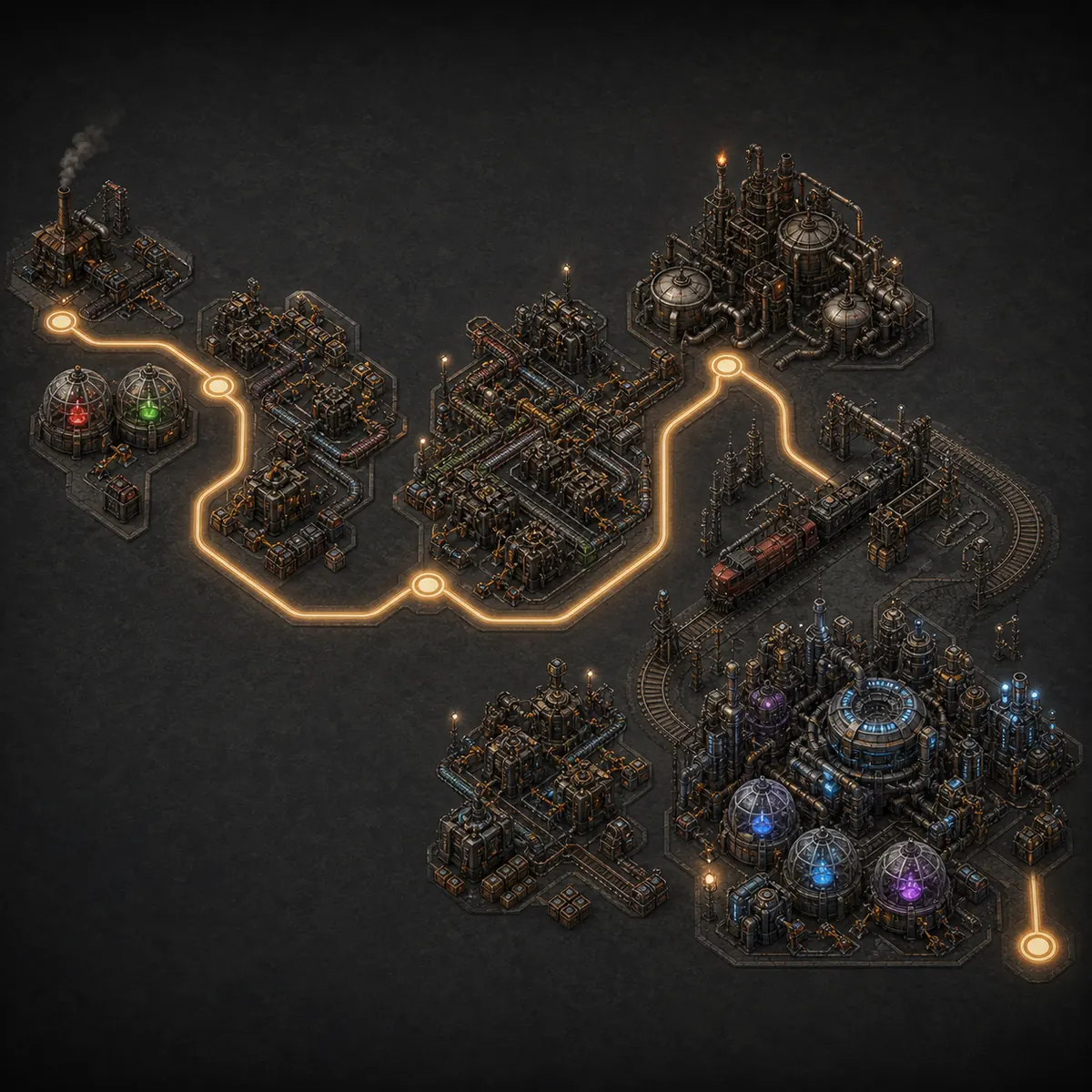
The tech tree tells you what an unlock enables; it does not size the factory that must feed the research. Once you choose the next branch, move from the tree to a concrete production target and verify the supporting chain.
Choose a science rate
Start with a sustainable target such as 60, 100 or 250 science per minute instead of guessing how many labs feel large enough.
Trace the recipe chain
Use the recipe or production calculator to see raw resources, intermediates, machines, modules, belts and fluids required by the chosen science branch.
Check the real bottleneck
Compare science demand with oil, circuits, smelting, power and transport capacity. The research queue may be fine while one upstream system quietly starves it.
Revisit the tree after expansion
When the factory reaches the target, open the technology view again. Your next best branch may have changed because the limiting system is no longer the same.
Turn the Next Research Unlock Into a Build Plan
Choose one technology, set a science target and verify the whole production chain before expanding the factory.
Factorio Tech Tree FAQ
What is the best Factorio tech tree research order?
There is no universal order. A reliable default is automation, logistics and safety, steel and oil preparation, chemical and production systems, then robots, modules, power and late-game logistics. Move a branch earlier when it removes your current bottleneck or unlocks the next factory milestone.
How do I pin items in the Factorio tech tree?
Select the technology or item in the technology view and use the available tracking or pin control so it remains visible while you build. The exact control can vary with the game version or interface context, so treat the pinned target as a reminder and confirm the prerequisite chain in the tree.
What is the difference between a Factorio tech tree and a research tree?
Players usually use both phrases for the same technology dependency map. Tech tree emphasizes branches and unlock connections; research tree emphasizes the queue and science process. This guide uses Factorio tech tree as the primary term because it matches the broader search wording.
Does Space Age have a different Factorio tech tree?
Space Age adds new technologies, planets, science packs, machines, platform systems and quality-related planning. The original dependency logic still matters, but the practical route becomes a network of local production and interplanetary logistics rather than one Nauvis-only chain.
Is there an online Factorio tech tree?
There are online references and visualizers, while the game itself remains the authoritative place to check the technology state for your current save and mod set. Use an online reference for orientation, then verify recipes, prerequisites and version details in the game or an up-to-date calculator.
Should I research infinite technologies before new unlocks?
Usually not if a new unlock removes a real bottleneck. Infinite research is most useful when the factory already produces a stable science surplus and the next repeatable bonus improves the system you are actively scaling.
Can I use this tech tree order for Factorio mods?
Use it only as a planning method, not as a fixed sequence. Large mods can replace science packs, prerequisites, machines and progression rules, so load the correct mod data and recalculate the branch before copying a vanilla or Space Age route.
Reference Sources
Use the official Factorio Wiki to verify technology names, prerequisites and expansion-specific details for the version or mod set you are playing.