Factorio Main Bus Guide: Items, Lanes, Layout & Upgrades
A good Factorio main bus is a reserved logistics corridor, not a promise to place every item on belts forever. Start with iron and copper capacity, leave room between lane groups, branch production in a predictable direction, and expand only when measured demand justifies another belt.
Last updated: July 29, 2026. Written for Factorio 2.0 and Space Age factory planning.
Quick Answer: What Should Go on a Factorio Main Bus?
For a flexible starter-to-rocket factory, reserve the most space for iron plates and copper plates, then add smaller lanes for green circuits, steel, plastic, coal, stone or bricks as your build needs them. Gears, copper cable and many low-volume products are usually better made beside the consumer instead of occupying permanent bus lanes.
- Begin with four lanes of iron and four lanes of copper if you want comfortable expansion; a smaller base can start with two each while reserving the extra width.
- Give green circuits two lanes when science, modules and higher-tier circuits will share the same bus.
- One lane is usually enough for steel, plastic, coal and stone or brick until demand proves otherwise.
- Build production on one side of the bus when possible so the other side remains available for lane additions and crossings.
- Use the calculator and belt-rate pages to size lanes from actual items per second instead of copying a huge bus blindly.
Treat the Bus as a Corridor with Reserved Capacity
The official Factorio screenshot shows the useful principle: long parallel belt groups create a readable backbone, while production branches occupy defined areas beside it. The exact screenshot is not a universal blueprint, but the separation between transport and production is the part worth copying.
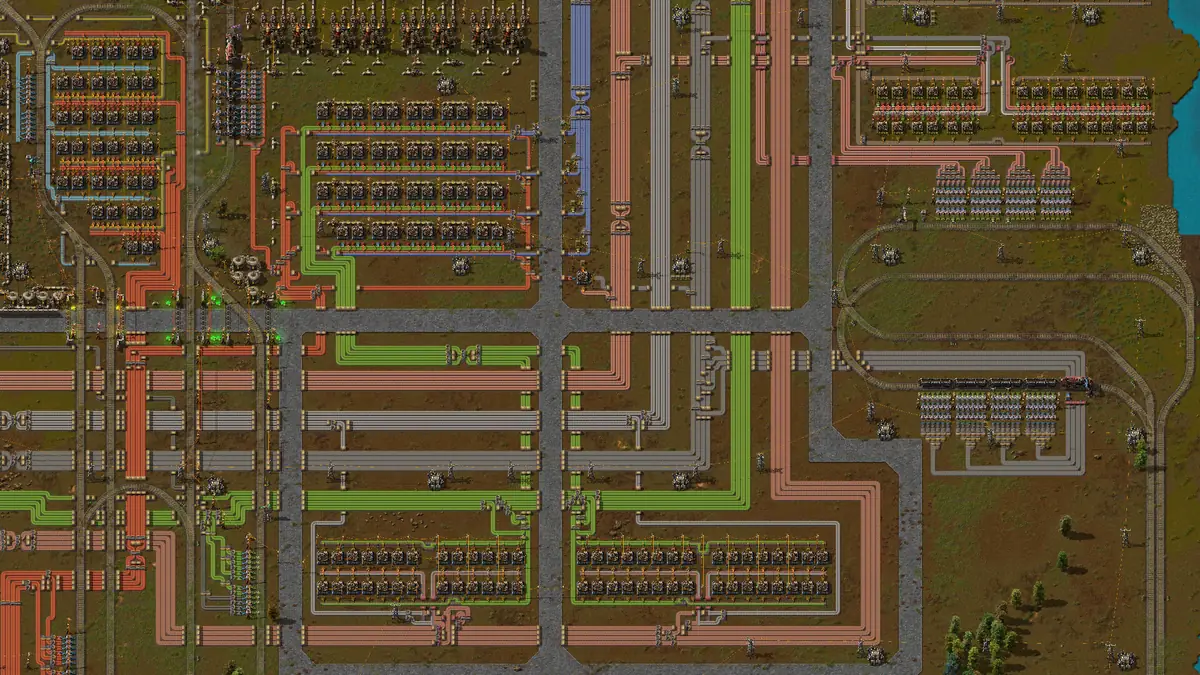
Factorio Main Bus Items and Lane Count
Lane counts are planning ranges, not laws. A belt should exist because downstream machines can consume its throughput. Reserve width early, but activate extra lanes only when production and consumption justify them.
| Material | Practical starting space | Why it belongs | When to change |
|---|---|---|---|
| Iron plates | 4 lanes reserved; 2 active for a smaller start | Belts, gears, steel, ammunition, engines and many science chains consume iron heavily | Add active lanes when downstream draw empties the bus before later branches |
| Copper plates | 4 lanes reserved; 2 active early | Copper cable, circuits, ammunition and later technologies can create sharp demand spikes | Scale before red circuits, modules and late science compete for the same supply |
| Electronic circuits | 1-2 lanes | Green circuits feed a large share of the factory and reduce repeated local cable-and-circuit builds | Use two lanes when modules, red circuits and blue circuits share the bus |
| Steel plates | 1 lane | Steel is widely used but has lower item flow than iron plates because each plate represents several iron plates | Add a second lane only for sustained rail, module, military or megabase demand |
| Plastic bars | 1 lane | Plastic connects oil processing to red circuits and several later products | Prefer a dedicated route or train if the refinery is far from the bus |
| Coal | 0-1 lane | Useful for plastic, grenades, military science and early fuel distribution | Remove or shorten it when consumers become localized or fuel logistics change |
| Stone / stone brick | 0-1 lane each or a shared local route | Needed for rails, furnaces, walls, concrete and infrastructure | Keep local if only one production district consumes it |
| Gears and copper cable | Usually no permanent lane | They are fast intermediate products and can consume bus width faster than they save machines | Bus gears only when many separated consumers create a measured logistics benefit |
Factorio Main Bus Layout, Spacing and Build Direction
A maintainable layout leaves crossing space, keeps inputs predictable and prevents early factories from trapping later upgrades. The common four-belt group is useful because underground belts can cross the group cleanly, but it is only one workable convention.
Group lanes with gaps
Use belt groups separated by walking and underground-crossing space. A pattern such as four belts, two empty tiles, then four belts is easy to read and expand, but wider service gaps are reasonable when pipes or power poles must cross.
Build on one side first
Placing assemblers mainly on one side preserves the opposite edge for new lanes, train unloading, fluids or a later redesign. Two-sided builds are compact, but they make the bus harder to widen.
Choose a flow direction
Let raw materials enter at one end and progressively more advanced production appear downstream. Consistent flow makes shortages visible and reduces belts that reverse direction across the corridor.
Reserve utility crossings
Plan repeated crossing points for power poles, pipes and player movement. Do not weave every new fluid line through a random splitter gap. Water, lubricant and sulfuric acid often work better in separate pipe corridors.
Leave room before science blocks
Science production tends to grow in stages. Reserve expansion rectangles beside the bus so a second row of assemblers can be added without moving the transport spine.
Keep the mall near useful inputs
A mall consumes many different ingredients at modest rates. Place it where iron, circuits, steel and other common materials can branch without sending finished infrastructure back across the entire base.
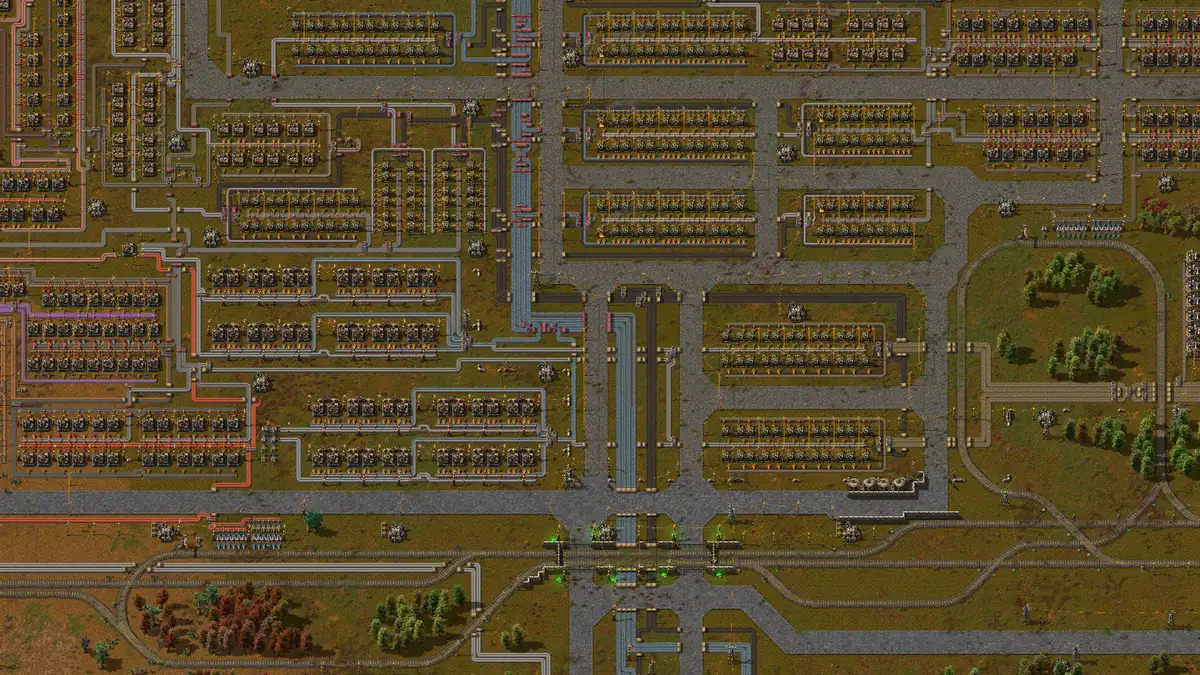
How to Branch from a Main Bus Without Starving the End
A branch should take the amount its production block needs while preserving understandable flow downstream. Priority splitters can help protect an important consumer or refill a preferred lane, but excessive priority rules can hide an undersized supply line.
| Branch method | Best use | Risk | Better check |
|---|---|---|---|
| Simple splitter branch | Normal production block with moderate demand | Repeated 50/50 splits can drain one side or make shortages appear unpredictably | Watch sustained belt compression after the branch |
| Priority output | Critical science, mall or ammunition line that should fill first | Downstream factories may be starved even when total supply is insufficient | Confirm the priority is intentional and measure the remaining flow |
| Lane tap with underground belts | Compact branch from a specific belt lane | Poorly repeated taps can favor one lane while the other stays full | Use lane balancing only where uneven consumption creates a real problem |
| Full belt peeled from the bus | Large smelting, circuits or science block | The bus loses an entire lane unless it is replenished | Inject a new upstream belt or treat the branch as the planned end of that lane |
| Train or bot delivery beside the bus | Late expansion or remote specialized production | Mixed logistics can become hard to debug | Define which network owns each material and avoid duplicate uncontrolled feeds |
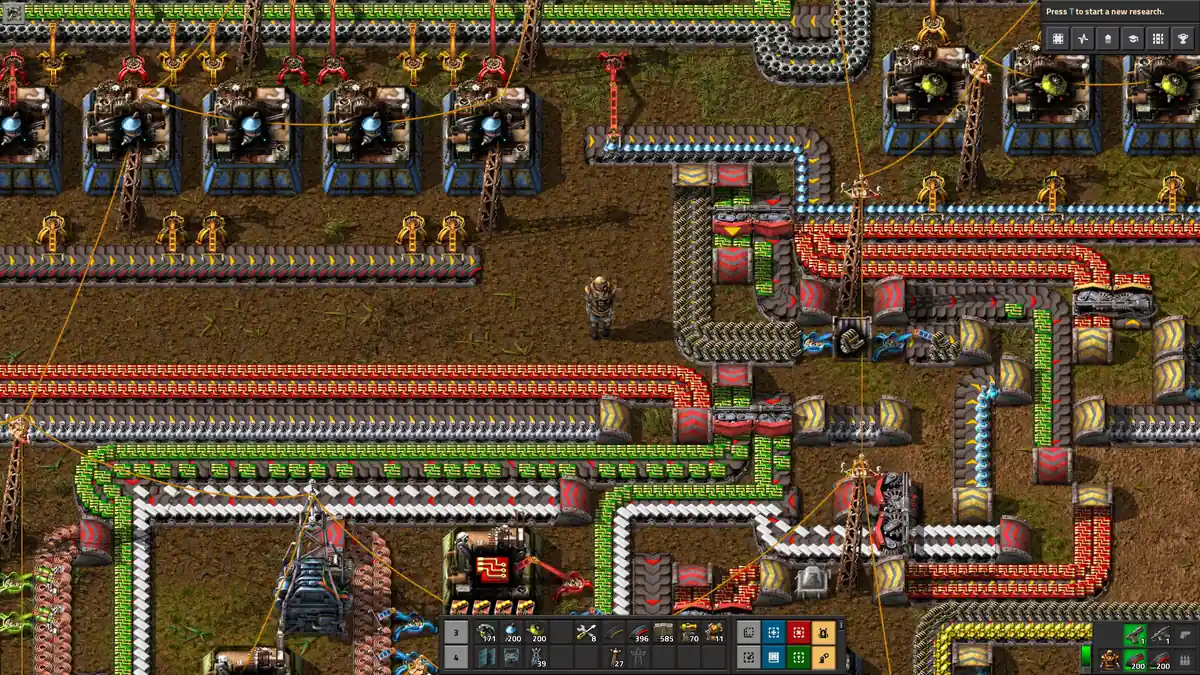
Early, Midgame and Late-Game Main Bus Upgrades
The bus should evolve with the factory. Upgrading every belt tier early wastes resources, while refusing to add supply after demand changes creates long stretches of half-empty downstream belts.
Reserve the final width
Mark the corridor for the iron, copper, circuits and support lanes you expect to need. You can leave future belts empty while the starter smelters feed only the first active lanes.
Build starter production in removable blocks
Keep early gears, circuits and science beside the corridor instead of inside it. Temporary builds are easier to replace when they do not interrupt the transport spine.
Upgrade supply before belt color
A faster belt cannot fix weak mining or smelting. Increase ore input, furnaces and plate output first, then upgrade the transport section that can actually stay compressed.
Add circuits and oil products deliberately
Green circuits usually earn permanent lanes. Plastic and advanced circuits should join where oil logistics and consumption make sense rather than being routed across the map for visual symmetry.
Measure the late-game bottleneck
Modules, beacons, higher science targets and Space Age production change ratios. Recalculate demand before adding more lanes or copying a larger blueprint.
Split the network when the bus stops helping
Move bulk remote production to trains, compact mixed deliveries to bots, and repeatable megabase production to city blocks when the central corridor becomes longer and harder to expand than the alternatives.
Main Bus vs Trains, Bots and City Blocks
A main bus is excellent for a readable first complete factory, but it is not automatically the best permanent megabase architecture. Choose the network that matches distance, volume, repetition and how often recipes change.
| Layout | Best at | Weak point | Use it when |
|---|---|---|---|
| Main bus | Visible flow, gradual expansion, starter-to-rocket progression | Long travel and difficult widening at very high throughput | You want one understandable factory backbone |
| Trains | Moving bulk materials across long distances | Stations, signaling and buffers add planning overhead | Ore fields and production districts are separated |
| Logistic bots | Many low-volume item types and compact flexible delivery | Power use and flight congestion grow with distance and volume | A mall, module area or specialized build needs mixed ingredients |
| City blocks | Repeatable rail modules and large production targets | Requires standards for block size, stations and train schedules | The factory is becoming a distributed megabase |
| Hybrid | Using each network for its strongest job | Ownership boundaries can become confusing | You define clear transfer points between belts, bots and trains |
Common Factorio Main Bus Mistakes
Putting every intermediate on the bus
Copper cable, gears and other fast intermediates can consume many lanes. Make them locally unless separated consumers justify shared transport.
Building on both sides too early
The factory looks compact until another iron or circuit lane is needed. Preserve one expansion edge until the bus width is proven.
Copying lane counts without a target
A bus designed for a huge science target wastes time in a modest factory. Calculate production demand and activate capacity in stages.
Using priority to hide shortages
Priority splitters can keep one block alive while everything downstream fails. Fix mining, smelting or upstream production when total supply is the problem.
Upgrading belts before producers
Red or blue belts remain sparse if furnaces cannot fill them. Upgrade the production chain and inserters together with transport.
Keeping the bus forever
A bus is a tool, not a rule. Transition bulk flows to trains or repeatable blocks when distance and throughput make the corridor awkward.
Size the bus from real production demand
Set a production target in the Factorio calculator, convert the result to items per second, then reserve only the belt lanes the factory can use.
Factorio Main Bus FAQ
What is a main bus in Factorio?
A main bus is a set of parallel belts that carries common materials through the factory so production blocks can branch from a predictable logistics backbone. It is a player-designed convention, not a required game system.
How many belts should a Factorio main bus have?
There is no fixed total. A flexible starter bus often reserves four iron lanes, four copper lanes, one or two green-circuit lanes and several single lanes for steel, plastic, coal or stone products. Activate lanes according to measured demand.
Should gears go on the main bus?
Usually not. Gears are quick to craft and iron plates are more flexible, so local gear production often saves bus space. A gear lane can make sense when many separated consumers create consistent demand.
Should a main bus be balanced?
It should deliver the required throughput, but it does not need a large balancer after every branch. Use simple splitters for normal taps, priority only for an intentional service rule, and lane or belt balancers when measured consumption is genuinely uneven.
Is a main bus better than city blocks?
A main bus is usually easier for a first complete factory and gradual progression. City blocks are better when production becomes modular, train-based and large enough to justify repeatable rail standards. Many bases transition from a bus to a hybrid or city-block design.
Does Space Age make the main bus obsolete?
No, but it makes a single all-purpose bus less likely to serve every planet and late-game chain. Use the bus for readable Nauvis progression, then combine local planetary production, trains, bots and specialized districts where those networks fit better.
Sources and Media
The layout recommendations are practical planning guidance. These official references document the game systems and provide the gameplay screenshots used on this page.