Factorio City Block Size Guide: Pick a Grid Before Rails Lock You In
The best Factorio city block size is not one universal number. It depends on train length, station layout, roboport coverage, chunk alignment, build density and how much empty routing space you are willing to reserve. Use this guide to choose a block before a rail blueprint becomes expensive to rebuild.
Last updated: July 1, 2026. Built for Factorio 2.0, Space Age rail planning and megabase layouts.
Quick Answer: What City Block Size Should You Use?
Most players should start around 96x96 or 100x100 tiles for a practical rail city block. Smaller blocks are compact but cramped; larger 128x128+ blocks are easier for trains, stations, roboports and beaconed production, but they consume more space and rails.
- Use 64x64 only for compact early experiments or non-train blocks.
- Use 96x96 or 100x100 when you want a balanced first rail city block grid.
- Use 128x128 when 1-4 or 2-4 trains, station bays, stackers and roboports need breathing room.
- Use 160x160 or larger for megabase modules, high-throughput train stations and bulky Space Age production.
- Pick a size after deciding train length and intersection style, not after building hundreds of rails.
City Blocks Work Best When Rails, Stations and Services Fit Together
A city block is a repeatable square or rectangle bounded by rail, road-like service corridors or power infrastructure. Good blocks leave enough inside space for production while keeping station bays, rail junctions, roboports and power poles predictable from block to block.
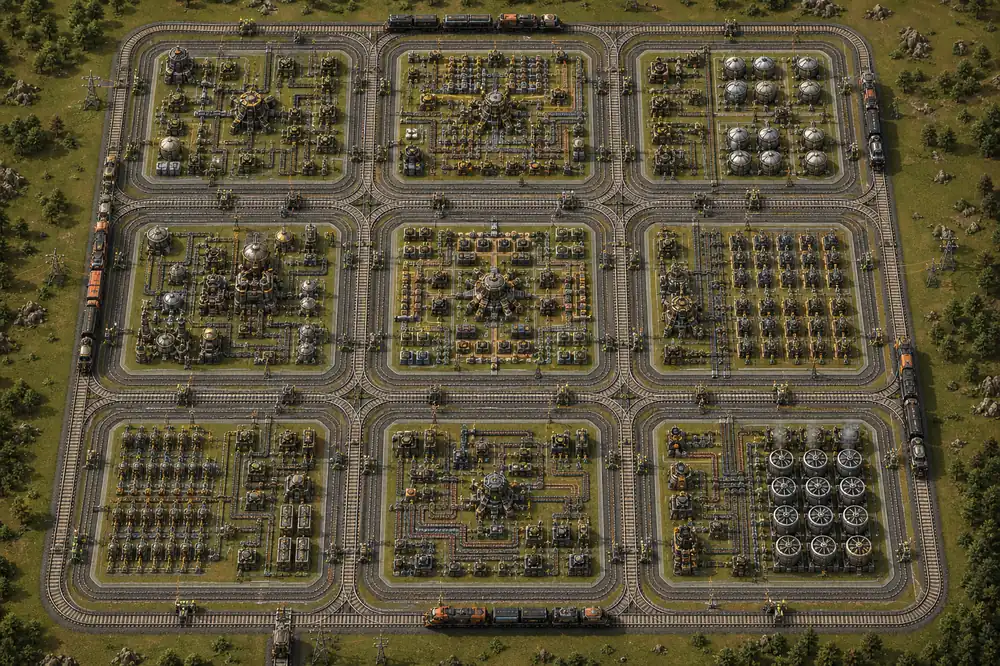
Factorio City Block Size Comparison Table
Start with the smallest block that still fits the rail and station pattern you actually plan to use. The numbers below are planning ranges, not fixed laws.
| Block size | Best use | Strengths | Main tradeoff |
|---|---|---|---|
| 64x64 tiles | Starter grid, compact science, no-train production cells | Fast to stamp down and easy to walk through | Usually too tight for rail stations, stackers and large beaconed builds |
| 96x96 tiles | First rail grid, mixed production, short trains | Good balance of space, roboport coverage and rail cost | Needs careful station design if trains are longer than 1-2 or 1-4 |
| 100x100 tiles | Chunk-friendly personal standard and early megabase grids | Easy to remember and gives a little more room than 96 | Not perfectly tied to every blueprint book or chunk habit |
| 128x128 tiles | Main rail city blocks, 1-4 or 2-4 trains, beaconed modules | Comfortable station bays, wider intersections and utility corridors | More rails and more empty interior if the factory is still small |
| 160x160+ tiles | Large megabase modules, high-throughput stations, Space Age builds | Room for stackers, multiple stations, broad bus lanes and expansion | Slow to walk, expensive to pave and wasteful if production density is low |
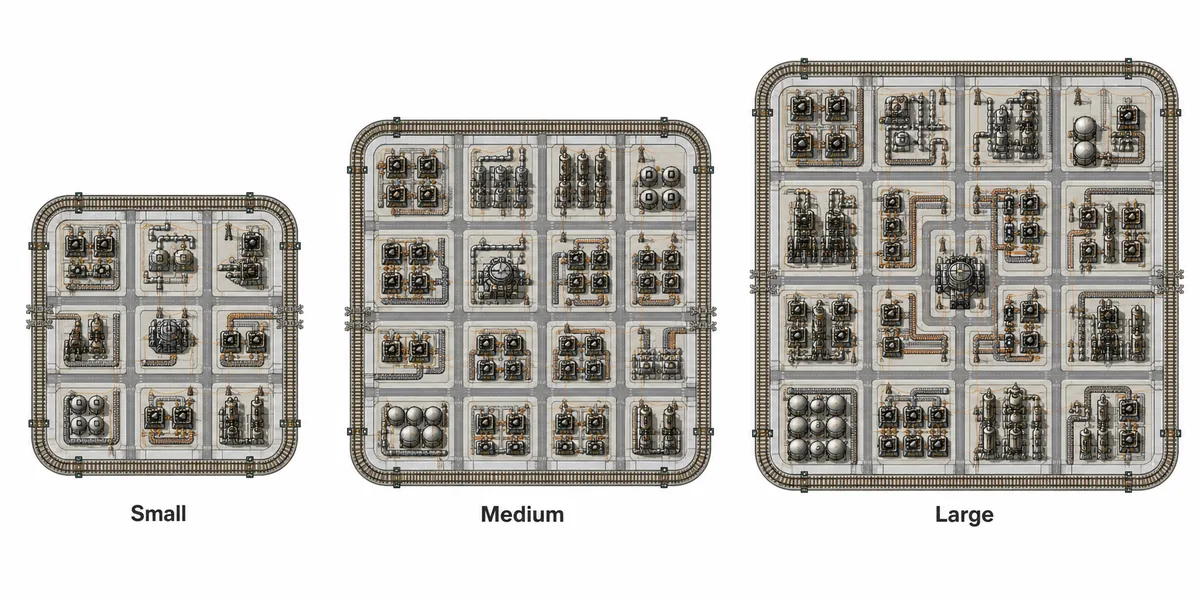
How to Choose a City Block Size
Choose the size by constraints that are hard to change later. Train length, rail intersections and station placement matter more than whether the number looks neat.
Train length
A 1-2 train can live in a tighter block than a 2-4 or 4-8 train. Leave room for station exits, signals and at least one train waiting without blocking the main rail.
Station direction
Side stations consume edge space, while through stations consume interior length. Decide whether stations live inside blocks, on edges, or in separate logistics blocks.
Roboport coverage
If construction bots build the grid, check whether roboport coverage overlaps block corners and service corridors. A neat rail grid that leaves bot gaps becomes tedious to expand.
Power and pipes
Reserve a predictable corridor for big electric poles, substations, fluid lines or circuit wires. Retrofitting utilities through finished production blocks is painful.
Production density
Beaconed builds, foundries, refineries, labs and rocket-related Space Age chains need more interior room than simple green circuit or belt builds.
Chunk alignment
Some players align blocks to chunks or radar ranges for blueprint snapping and map readability. This is useful, but it should not override station fit.
Rail, Station and Roboport Layout Checks
Before stamping a grid across the map, test one complete block with rail intersections, station bays, loading buffers, roboports and power. A city block that looks clean empty may fail when trains queue.
| Check | Why it matters | Practical test |
|---|---|---|
| Intersection footprint | Large four-way junctions eat corner space and can reduce interior build area | Place the exact intersection blueprint in all four corners before finalizing size |
| Station bay length | Stations need train length, signals, loading belts and sometimes stacker room | Fit one full loaded train plus entry and exit signals without blocking through traffic |
| Unload throughput | The block must move items from wagons to belts or bots fast enough | Compare station output with the rate calculator or train calculator target |
| Roboport overlap | Construction and logistic networks should connect predictably | Check coverage circles at corners and service lanes, not only at block centers |
| Power backbone | Big poles and substations should be repeatable across the grid | Run power along rails or a service strip before filling production space |
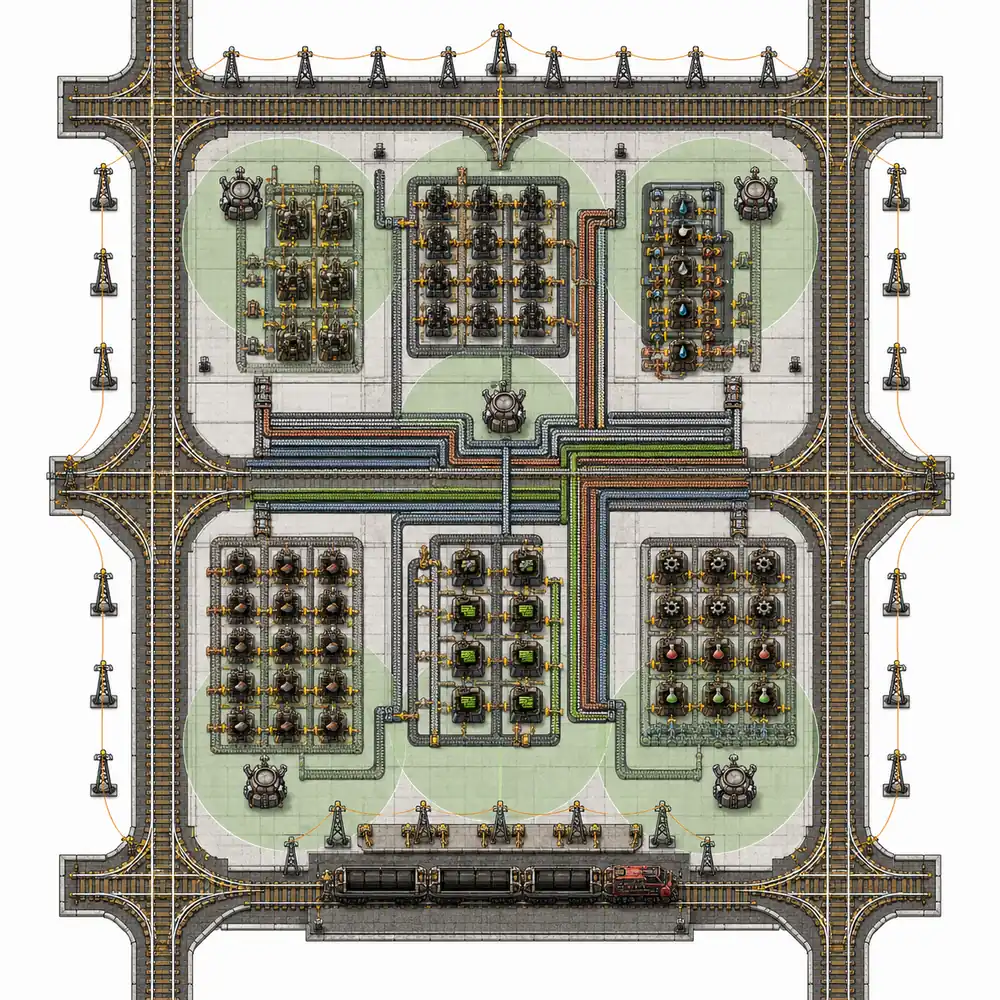
Recommended City Block Planning Workflow
Pick the train standard first
Choose whether the base uses 1-2, 1-4, 2-4 or larger trains. Train length drives station bay length and signal spacing.
Place one real corner intersection
Use the actual rail blueprint, including signals and turns. Do not estimate corner size from straight rail alone.
Add station and service lanes
Fit loading belts, unloading buffers, power poles, roboports and walking or vehicle paths before filling the interior.
Test a production block
Try one real module such as smelting, circuits, oil, science or mall supply. If the build barely fits, increase block size before scaling.
Stamp only after the template survives traffic
Let trains path through a few connected blocks and watch for deadlocks, blocked exits and impossible expansion points.
Common City Block Size Mistakes
| Mistake | What happens | Better choice |
|---|---|---|
| Choosing a block before choosing train length | Stations either do not fit or block intersections | Select train length and station style first |
| Using 64x64 for every rail block | Rail corners and station bays consume most of the interior | Reserve small blocks for compact cells or move up to 96/100/128 |
| Making every block huge too early | The base becomes expensive, sparse and slow to navigate | Use larger blocks only where stations or beaconed production justify them |
| Ignoring bot coverage | Construction stalls at block borders and repair coverage has gaps | Place roboports before finalizing blueprint dimensions |
| Mixing many block sizes randomly | Blueprint snapping and rail alignment become harder | Use one main size and a few deliberate support blocks |
Need production demand before sizing the block?
Use the main Factorio calculator to estimate belts, machines and item rates, then choose whether the block needs compact production, train stations or full megabase expansion space.
Factorio City Block Size FAQ
What is the best Factorio city block size?
For most rail-grid bases, 96x96, 100x100 or 128x128 tiles are safer starting points than very small blocks. Choose based on train length, station space and roboport coverage.
Is 64x64 too small for city blocks?
It is often too small for rail city blocks with stations, stackers and intersections, but it can work for compact production cells or early no-train blocks.
Why do many players use 100x100 or 128x128 blocks?
Those sizes are easy to blueprint, leave enough interior room for production and make rail corners, stations, power poles and roboports easier to repeat.
Should city blocks align to chunks?
Chunk alignment can make blueprints and map reading cleaner, but it is secondary to whether trains, stations, roboports and production actually fit.
Do Space Age factories need larger city blocks?
Often yes. Foundries, electromagnetic plants, recycling loops, rocket logistics and multi-planet supply buffers can need more room than older vanilla production blocks.
Sources and Further Reading
These references help verify rail entities, train stops, roboport coverage and map structure while planning a city block grid.